cloud
English
Etymology
From Middle English cloud, cloude, clod, clud, clude, from Old English clūd (“mass of stone, rock, boulder, hill”), from Proto-Germanic *klūtaz, *klutaz (“lump, mass, conglomeration”), from Proto-Indo-European *gel- (“to ball up, clench”). Cognate with Scots cloud, clud (“cloud”), Dutch kluit (“lump, mass, clod”), German Low German Kluut, Kluute (“lump, mass, ball”), German Kloß (“lump, dumpling, meatball”), Danish klode (“sphere, orb, planet”), Swedish klot (“sphere, orb, ball, globe”), Icelandic klót (“knob on a sword's hilt”). Related to clod, clot, clump, club.
Pronunciation
- (Received Pronunciation, General American) enPR: kloud, IPA(key): /klaʊd/
Audio (US) (file) Audio (UK) (file) - Rhymes: -aʊd
Noun
cloud (plural clouds)
- (obsolete) A rock; boulder; a hill.
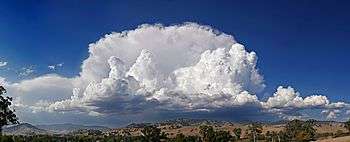
- A visible mass of water droplets suspended in the air.
- 1908, W[illiam] B[lair] M[orton] Ferguson, Zollenstein, New York, N.Y.: D. Appleton & Company, OCLC 29686887 , chapter IV:
- So this was my future home, I thought! […] Backed by towering hills, the but faintly discernible purple line of the French boundary off to the southwest, a sky of palest Gobelin flecked with fat, fleecy little clouds, it in truth looked a dear little city; the city of one's dreams.
- 1908, W[illiam] B[lair] M[orton] Ferguson, Zollenstein, New York, N.Y.: D. Appleton & Company, OCLC 29686887 , chapter IV:
- Any mass of dust, steam or smoke resembling such a mass.
- 2013 June 29, “Unspontaneous combustion”, in The Economist, volume 407, number 8842, page 29:
- Since the mid-1980s, when Indonesia first began to clear its bountiful forests on an industrial scale in favour of lucrative palm-oil plantations, “haze” has become an almost annual occurrence in South-East Asia. The cheapest way to clear logged woodland is to burn it, producing an acrid cloud of foul white smoke that, carried by the wind, can cover hundreds, or even thousands, of square miles.
-
- Anything which makes things foggy or gloomy.
- A group or swarm, especially suspended above the ground or flying.
- He opened the door and was greeted by a cloud of bats.
- An elliptical shape or symbol whose outline is a series of semicircles, supposed to resemble a cloud.
- The comic-book character's thoughts appeared in a cloud above his head.
- (computing, with "the") The Internet, regarded as an abstract amorphous omnipresent space for processing and storage, the focus of cloud computing.
- 2013 June 14, Jonathan Freedland, “Obama's once hip brand is now tainted”, in The Guardian Weekly, volume 189, number 1, page 18:
- Now we are liberal with our innermost secrets, spraying them into the public ether with a generosity our forebears could not have imagined. Where we once sent love letters in a sealed envelope, or stuck photographs of our children in a family album, now such private material is despatched to servers and clouds operated by people we don't know and will never meet.
-
- (figuratively) A negative aspect of something positive: see every cloud has a silver lining or every silver lining has a cloud.
- 2011 January 25, Phil McNulty, “Blackpool 2-3 Man Utd”, in BBC:
- The only cloud on their night was that injury to Rafael, who was followed off the pitch by his anxious brother Fabio as he was stretchered away down the tunnel.
-
- (slang) Crystal methamphetamine.
- A large, loosely-knitted headscarf worn by women.
Quotations
- For quotations of use of this term, see Citations:cloud.
Hyponyms
- See also Thesaurus:cloud
Derived terms
Related terms
Translations
|
|
|
|
- The translations below need to be checked and inserted above into the appropriate translation tables, removing any numbers. Numbers do not necessarily match those in definitions. See instructions at Wiktionary:Entry layout#Translations.
|
|
See also


- Appendix:English collective nouns
Verb
cloud (third-person singular simple present clouds, present participle clouding, simple past and past participle clouded)
- (intransitive) To become foggy or gloomy, to become obscured from sight.
- The glass clouds when you breathe on it.
- (transitive) To overspread or hide with a cloud or clouds.
- The sky is clouded.
- (transitive) To make obscure.
- All this talk about human rights is clouding the real issue.
- (transitive) To make less acute or perceptive.
- Your emotions are clouding your judgement.
- The tears began to well up and cloud my vision.
- (transitive) To make gloomy or sullen.
- Shakespeare
- One day too late, I fear me, noble lord, / Hath clouded all thy happy days on earth.
- Milton
- Be not disheartened, then, nor cloud those looks.
- Shakespeare
- (transitive) To blacken; to sully; to stain; to tarnish (reputation or character).
- Shakespeare
- I would not be a stander-by to hear / My sovereign mistress clouded so, without / My present vengeance taken.
- Shakespeare
- (transitive) To mark with, or darken in, veins or sports; to variegate with colours.
- to cloud yarn
- Alexander Pope
- the nice conduct of a clouded cane
Translations
- The translations below need to be checked and inserted above into the appropriate translation tables, removing any numbers. Numbers do not necessarily match those in definitions. See instructions at Wiktionary:Entry layout#Translations.
|
|
Anagrams
French
Noun
cloud m (uncountable)
- (computing, Anglicism, with le) the cloud.
Synonyms
- le nuage
See also
Spanish
Noun
cloud m (plural clouds)