bull
English
Pronunciation
- IPA(key): /ˈbʊl/
Audio (US) (file) - Rhymes: -ʊl
Etymology 1
From Middle English bole, bul, bule, from a conflation of Old English bula (“bull, steer”) and Old Norse boli, from Proto-Germanic *bulô (“bull”); compare West Frisian bolle, Dutch bul, German Bulle, Old Norse boli, from Proto-Indo-European *bʰl̥no- (compare Old Irish ball (“limb”), Latin follis (“bellows, leather bag”), Thracian βόλινθος (“wild bull”), Albanian buall (“buffalo”) or related bolle (“testicles”), Ancient Greek φαλλός (phallós, “penis”)), from Proto-Indo-European *bʰel- (“to blow”). More at blow.
Noun
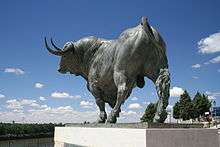
bull (countable and uncountable, plural bulls)
- An adult male of domesticated cattle or oxen.
- Specifically, one that is uncastrated.
- A male of domesticated cattle or oxen of any age.
- An adult male of certain large mammals, such as whales, elephants and seals.
- A large, strong man.
- (finance) An investor who buys (commodities or securities) in anticipation of a rise in prices.
- (slang) A policeman.
- 1920, Mary Roberts Rinehart, Avery Hopwood, The Bat, chapterI:
- The Bat—they called him the Bat. […]. He'd never been in stir, the bulls had never mugged him, he didn't run with a mob, he played a lone hand, and fenced his stuff so that even the fence couldn't swear he knew his face.
- 1920, Mary Roberts Rinehart, Avery Hopwood, The Bat, chapterI:
- (Britain, historical, obsolete slang) A crown coin; its value, 5 shillings.
- 1859, J.C. Hotten, A Dictionary of Modern Slang, Cant, and Vulgar Words
- Half-a-crown is known as an alderman, half a bull, half a tusheroon, and a madza caroon; whilst a crown piece, or five shillings, may be called either a bull, or a caroon, or a cartwheel, or a coachwheel, or a thick-un, or a tusheroon.
- 1859, J.C. Hotten, A Dictionary of Modern Slang, Cant, and Vulgar Words
- (Britain) Clipping of bullseye.
- (Philadelphia, slang) A man.
- (uncountable, vulgar, slang) Clipping of bullshit..
Synonyms
Antonyms
- (finance: investor who buys in anticipation of a rise in prices): bear
Coordinate terms
Derived terms
Translations
|
|
|
- The translations below need to be checked and inserted above into the appropriate translation tables, removing any numbers. Numbers do not necessarily match those in definitions. See instructions at Wiktionary:Entry layout#Translations.
Adjective
bull (not comparable)
- Large and strong, like a bull.
- (of large mammals) adult male
- a bull elephant
- (finance) Of a market in which prices are rising (compare bear)
- stupid
Synonyms
Antonyms
Translations
Etymology 2
Shortened from bullshit
Verb
bull (third-person singular simple present bulls, present participle bulling, simple past and past participle bulled)
- (intransitive) To force oneself (in a particular direction).
- He bulled his way in.
- (intransitive) To lie, to tell untruths.
- (intransitive) To be in heat; to manifest sexual desire as cows do.
- (Britain, military) To polish boots to a high shine.
- (finance, transitive) To endeavour to raise the market price of.
- to bull railroad bonds
- (finance, transitive) To endeavour to raise prices in.
- to bull the market
Translations
Derived terms
Etymology 3
From Middle English bulle, from Old French bulle, from Low Latin bulla.
Noun
bull (plural bulls)
- A papal bull, an official document or edict from the Pope.
- A seal affixed to a document, especially a document from the Pope.
Translations
Verb
bull (third-person singular simple present bulls, present participle bulling, simple past and past participle bulled)
- (dated, 17th century) to publish in a Papal bull
Etymology 4
From Middle English bull (“falsehood”), of unknown origin. Possibly related to Old French boul, boule, bole (“fraud, deceit, trickery”). Popularly associated with bullshit.
Noun
bull (uncountable)
Synonyms
- (nonsense): See also Thesaurus:nonsense
Translations
Verb
bull (third-person singular simple present bulls, present participle bulling, simple past and past participle bulled)
- to mock, cheat
Etymology 5
From Old French boule (“ball”), from Latin bulla (“round swelling”), from Proto-Indo-European *bhel (“to blow, to swell”).
Noun
bull (plural bulls)
- (16th century, obsolete) a bubble
Catalan
Pronunciation
- IPA(key): /buʎ/
- Homophone: vull
- Rhymes: -uʎ
Etymology 1
From bullir.
Noun
bull m (plural bulls)
Verb
bull
Etymology 2
Noun
bull m (plural bulls)
Further reading
- “bull” in Diccionari de la llengua catalana, segona edició, Institut d’Estudis Catalans.
French
Etymology
From bulldozer.
Pronunciation
- IPA(key): /bul/, /byl/
Noun
bull m (plural bulls)
- (construction) bulldozer
Synonyms
Icelandic
Pronunciation
- IPA(key): /pʏtl/
- Rhymes: -ʏtl
Noun
bull n (genitive singular bulls, no plural)
Declension
Synonyms
Related terms
- bulla (“to talk nonsense, to boil”)
Westrobothnian
Etymology
From Old Norse bolli, from Proto-Germanic *bullô.
Noun
bull m