amor
Asturian
Etymology
Noun
amor m (plural amores)
Related terms
Catalan
Etymology
From Old Occitan amor, from Latin amōre, singular ablative of amor.
Pronunciation
Noun
amor m (plural amors)
Derived terms
Related terms
Further reading
- “amor” in Diccionari de la llengua catalana, segona edició, Institut d’Estudis Catalans.
Chavacano
Etymology
Noun
amor
Galician
Etymology
From Old Portuguese amor, from Latin amor, amōrem.
Pronunciation
- IPA(key): [aˈmoɾ]
Noun
amor m (plural amores)
Antonyms
Related terms
Icelandic
Etymology
Noun
amor m (genitive singular amors, no plural)
- (rare) love
Synonyms
Derived terms
- amorslegur
Interlingua
Etymology
Noun
amor
Italian
Noun
amor m (invariable)
- Apocopic form of amore
Anagrams
Ladino
Noun
amor m (Latin spelling)
Latin
Pronunciation
- (Classical) IPA(key): /ˈa.mor/
Etymology 1
Noun
amor m (genitive amōris); third declension
- love
- Amor omnia vincit.
- Love conquers all.
- Amor omnia vincit.
- beloved
- sex
- (plural only) love affair
Inflection
Third declension.
| Case | Singular | Plural |
|---|---|---|
| nominative | amor | amōrēs |
| genitive | amōris | amōrum |
| dative | amōrī | amōribus |
| accusative | amōrem | amōrēs |
| ablative | amōre | amōribus |
| vocative | amor | amōrēs |
Descendants
- Aragonese: amor
- Asturian: amor
- Catalan: amor
- Corsican: amore, amori
- Dalmatian: amaur
- Extremaduran: amol
- French: amour
- English: amour (borrowed)
- Friulian: amôr
- Galician: amor
- Icelandic: amor (borrowed)
- Istriot: amure
- Italian: amore
- Mirandese: amor
- Leonese: amor
- Norman: amour
- Occitan: amor
- Old Occitan: amor
- Old Portuguese: amor
- Piedmontese: amor
- Portuguese: amor
- Romanian: amor
- Romansch: amur
- Sardinian: amore, amori, more
- Sicilian: amuri
- Spanish: amor
- Venetian: amor
Etymology 2
Inflected form of amō (“I love”).
Verb
amor
- first-person singular present passive indicative of amō
Verb
amem
- first-person singular present active subjunctive of amō
Verb
amer
- first-person singular present passive subjunctive of amō
References
- amor in Charlton T. Lewis and Charles Short (1879) A Latin Dictionary, Oxford: Clarendon Press
- amor in Charlton T. Lewis (1891) An Elementary Latin Dictionary, New York: Harper & Brothers
- amor in Charles du Fresne du Cange’s Glossarium Mediæ et Infimæ Latinitatis (augmented edition, 1883–1887)
- amor in Gaffiot, Félix (1934) Dictionnaire Illustré Latin-Français, Hachette
- Carl Meissner; Henry William Auden (1894) Latin Phrase-Book, London: Macmillan and Co.
- to feel affection for a person: in amore habere aliquem
- to feel affection for a person: amore prosequi, amplecti aliquem
- to be fired with love: amore captum, incensum, inflammatum esse, ardere
- to banish love from one's mind: amorem ex animo eicere
- somebody's darling: amores et deliciae alicuius
- to be some one's favourite: in amore et deliciis esse alicui (active in deliciis habere aliquem)
- to feel affection for a person: in amore habere aliquem
- amor in Harry Thurston Peck, editor (1898) Harper's Dictionary of Classical Antiquities, New York: Harper & Brothers
- amor in William Smith, editor (1848) A Dictionary of Greek Biography and Mythology, London: John Murray
Occitan
Alternative forms
- amour (Mistralian)
Etymology
From Old Occitan amor, from Latin amor, amōrem.
Noun
amor m (plural amors)
Related terms
Old French
Alternative forms
Etymology
From Latin amor, amōrem.
Noun
amor m, f (oblique plural amors, nominative singular amors, nominative plural amor)
Usage notes
- Attestable as both a masculine and a feminine noun, sometimes both in the same text
- Often capitalized because of the perceived importance of the word
Descendants
Old Occitan
Etymology
Noun
amor m (oblique plural amors, nominative singular amors, nominative plural amor)
- love
- c. 1160, Raimbaut d'Aurenga, vers:
- Assatz sai d’amor ben parlar [...].
- Well I know how to speak of love.
- c. 1160, Raimbaut d'Aurenga, vers:
Descendants
Old Portuguese
Etymology
Pronunciation
- IPA(key): /aˈmoɾ/
Noun
amor m
- love
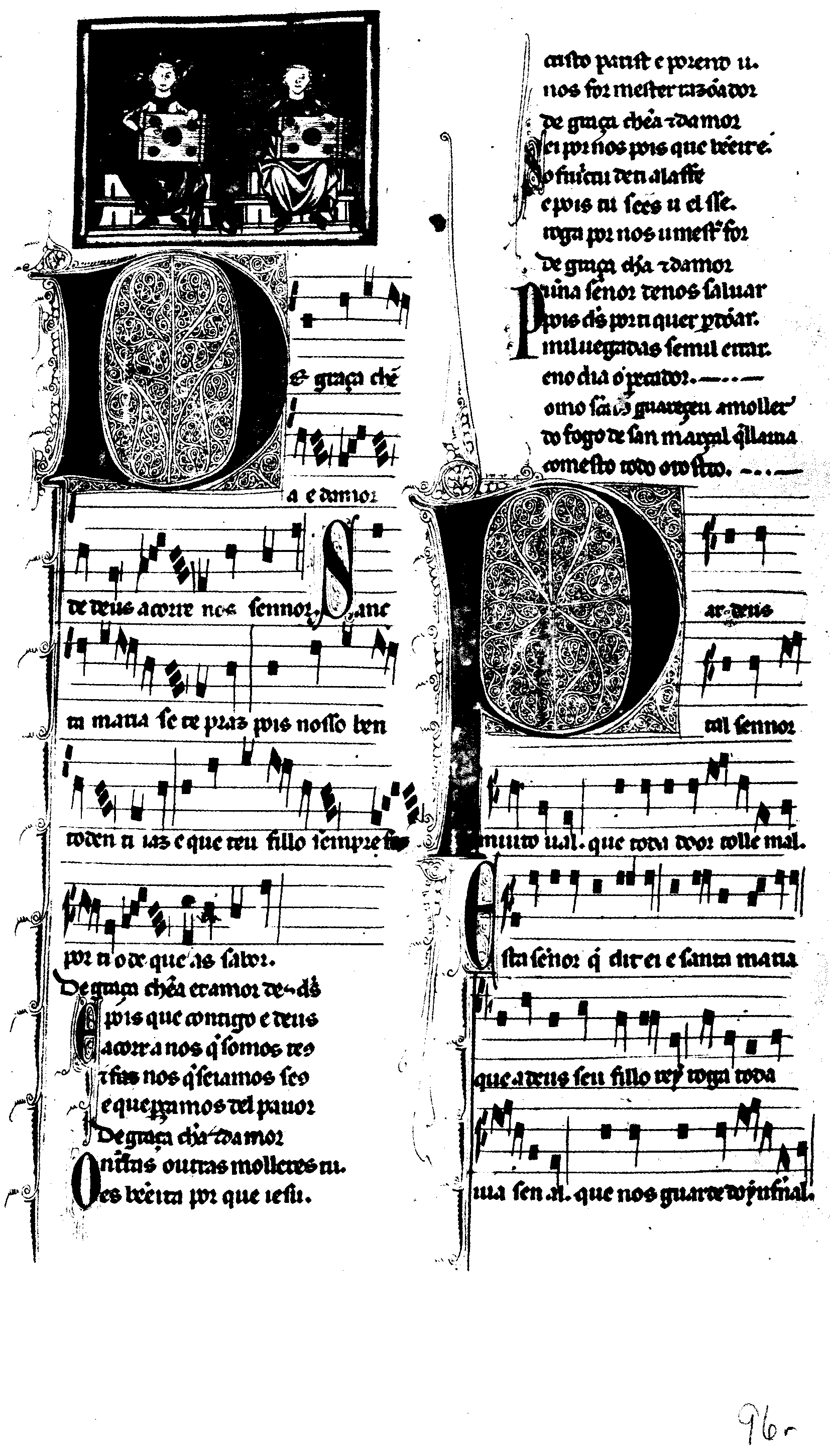
- 13th century, attributed to Alfonso X of Castile, Cantigas de Santa Maria, E codex, cantiga 80 (facsimile):
- De graça chẽa e damor / de deus acorre nos ſennor.
- (Our) Lady, full of grace and of God's love, come to our aid.
- De graça chẽa e damor / de deus acorre nos ſennor.
- 13th century, attributed to Alfonso X of Castile, Cantigas de Santa Maria, E codex, cantiga 80 (facsimile):
Descendants
Portuguese
Etymology
From Old Portuguese amor, from Latin amor, amōrem, from amō (“I love”).
Cognate with Galician amor, Spanish amor, Catalan amor, Occitan amor, French amour, Italian amore and Romanian amor.
Pronunciation
Noun
amor m (plural amores)
- love
- 1607, Luís Vaz de Camões, Rimas, Amor é fogo que arde sem se ver:
- Amor he hum fogo que arde ſem ſe ver
- Love is a fire that burns but is not seen
- Amor he hum fogo que arde ſem ſe ver
- 1607, Luís Vaz de Camões, Rimas, Amor é fogo que arde sem se ver:
- honey (term of affection)
- Amor, cheguei.
- Honey, I'm home.
Synonyms
- (honey): querido
Antonyms
Derived terms
Related terms
Anagrams
Romanian
Etymology
Borrowed from Latin amor, borrowed from French amour, borrowed from Italian amore.
Noun
amor n (plural amoruri)
Declension
| singular | plural | |||
|---|---|---|---|---|
| indefinite articulation | definite articulation | indefinite articulation | definite articulation | |
| nominative/accusative | (un) amor | amorul | (niște) amoruri | amorurile |
| genitive/dative | (unui) amor | amorului | (unor) amoruri | amorurilor |
| vocative | amorule | amorurilor | ||
Synonyms
Further reading
- amor in DEX online - Dicționare ale limbii române (Dictionaries of the Romanian language), 2004-2018
Spanish
 |
This entry is part of the phrasebook project, which presents criteria for inclusion based on usefulness, simplicity and commonness. |
Etymology
Pronunciation
- IPA(key): /aˈmoɾ/
Audio (file) - Rhymes: -oɾ
Noun
amor m (plural amores)
- love
- Antonym: desamor
- love affair
Derived terms
Anagrams
References
- “amor” in Diccionario de la lengua española, Vigésima tercera edición, Real Academia Española, 2014.