seitan
See also: Seitan
English
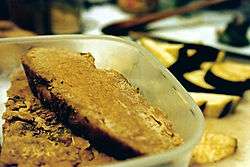
A piece of seitan
Etymology
According to the Oxford English Dictionary, the term was coined in Japanese by philosopher George Ohsawa in the early 1960s to refer to wheat gluten as used in Ohsawa's macrobiotic system of cooking and health. The exact derivation is uncertain. The first syllable may be from 生 (sei, “life”), 正 (sei, “proper, correct”), or 製 (sei, “made of”), while the second syllable is from 蛋 (tan, from 蛋白 (tanpaku, “protein”)). In Japan, wheat gluten itself is usually referred to as 麩 (fu, “wheat bran, gluten”), while seitan in particular is generally written in katakana as セイタン.
Pronunciation
- IPA(key): /ˈseɪtən/, IPA(key): /ˈseɪtɑn/
- Rhymes: -eɪtən
- Homophone: Satan
Noun
seitan (uncountable)
- Specially processed wheat gluten, used as a protein-rich food.
- 1994, Leonard Jacobs, Cooking with Seitan: The Complete Vegetarian "wheat-meat" Cookbook, Penguin →ISBN, page 28
- Pan-simmer baked seitan cutlets in Basic Broth (page 20) or other seasoned stock for 15 minutes.
- 1994, Leonard Jacobs, Cooking with Seitan: The Complete Vegetarian "wheat-meat" Cookbook, Penguin →ISBN, page 28
Derived terms
Translations
Anagrams
Italian
Etymology
Noun
seitan m (invariable)
Japanese
Romanization
seitan
This article is issued from
Wiktionary.
The text is licensed under Creative Commons - Attribution - Sharealike.
Additional terms may apply for the media files.