黄
| ||||||||
Translingual
| Stroke order | |||
|---|---|---|---|
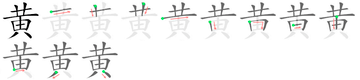 | |||
| Stroke order | |||
|---|---|---|---|
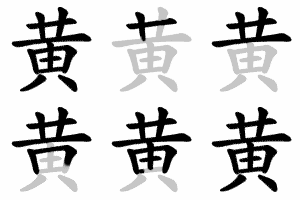 | |||
Glyph origin
Variant of 黃.
Han character
黄 (radical 201, 黃+0, 11 strokes, cangjie input 廿中田金 (TLWC), composition ⿳龷由八(GHJV) or ⿳龷田八(T))
References
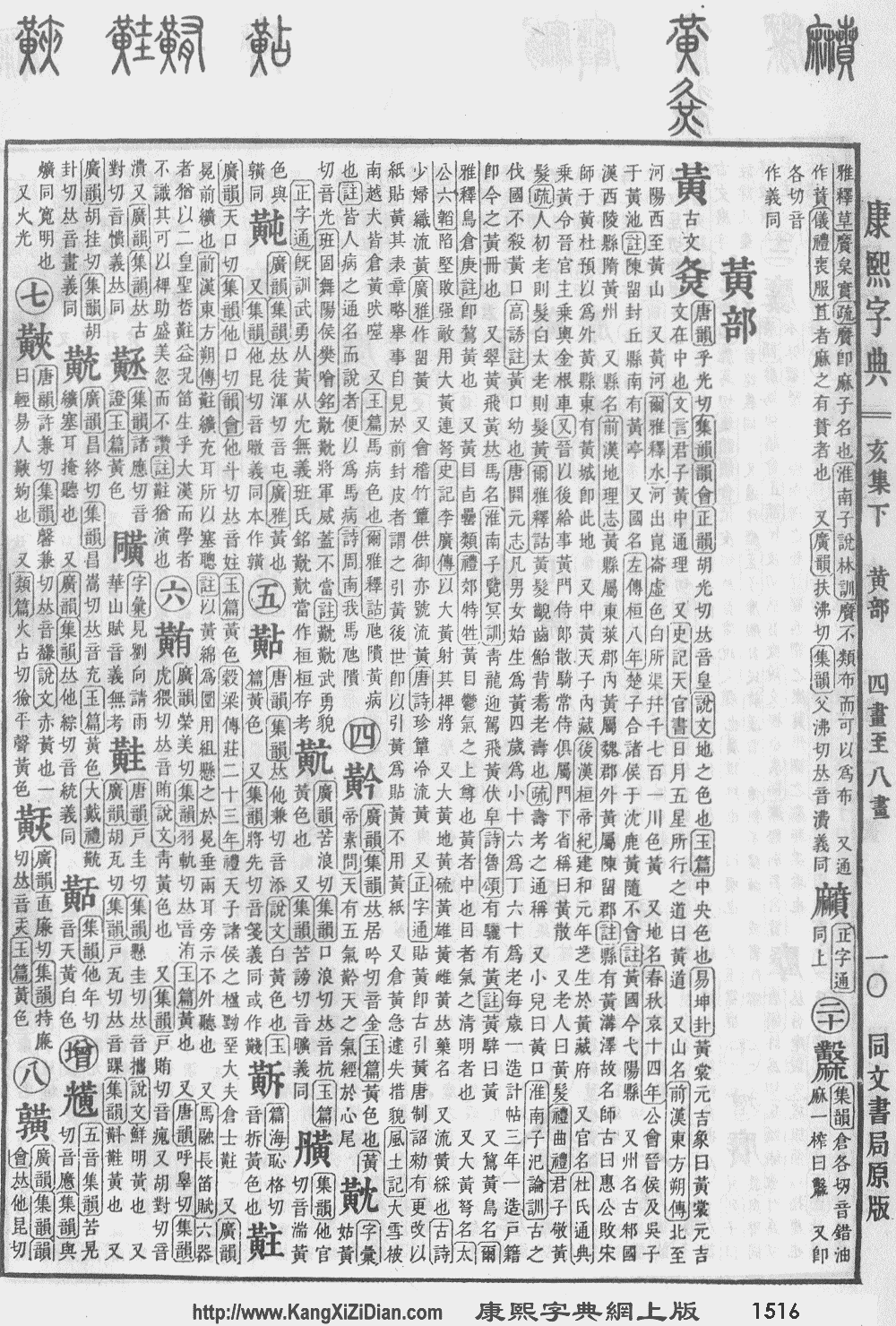
- KangXi: not present, would follow page 1516, character 4
- Dai Kanwa Jiten: character 47926
- Dae Jaweon: page 2048, character 1
- Hanyu Da Zidian: volume 7, page 4596, character 1
- Unihan data for U+9EC4
Chinese
Glyph origin
| Historical forms of the character 黄 | |||
|---|---|---|---|
| Shang | Western Zhou | Shuowen Jiezi (compiled in Han) | Liushutong (compiled in Ming) |
| Oracle bone script | Bronze inscriptions | Small seal script | Transcribed ancient scripts |
 |
 |
 |
 |
Definitions
| For pronunciation and definitions of 黄 – see 黃 (“yellow; yolk; etc.”). (This character, 黄, is the simplified and variant form of 黃.) |
Notes:
|
Japanese
| 黄 | |
| 黃 |
Kanji
黄
(grade 2 “Kyōiku” kanji, shinjitai kanji, kyūjitai form 黃)
Readings
Compounds
- 姜黄 (kyōō), 薑黄 (kyōō): wild turmeric
- 黄信号 (kishingō): yellow light
| Kanji in this term |
|---|
| 黄 |
| き Grade: 2 |
| kun’yomi |
Etymology
From Proto-Japonic *koi.
Pronunciation
Adjectival noun
黄 (shinjitai kanji, kyūjitai kanji 黃, -na inflection, hiragana き, rōmaji ki)
Inflection
Inflection of 黄
| Stem forms | |||
|---|---|---|---|
| Imperfective (未然形) | 黄だろ | きだろ | ki daro |
| Continuative (連用形) | 黄で | きで | ki de |
| Terminal (終止形) | 黄だ | きだ | ki da |
| Attributive (連体形) | 黄な | きな | ki na |
| Hypothetical (仮定形) | 黄なら | きなら | ki nara |
| Imperative (命令形) | 黄であれ | きであれ | ki de are |
| Key constructions | |||
| Informal negative | 黄ではない 黄じゃない |
きではない きじゃない |
ki de wa nai ki ja nai |
| Informal past | 黄だった | きだった | ki datta |
| Informal negative past | 黄ではなかった 黄じゃなかった |
きではなかった きじゃなかった |
ki de wa nakatta ki ja nakatta |
| Formal | 黄です | きです | ki desu |
| Formal negative | 黄ではありません 黄じゃありません |
きではありません きじゃありません |
ki de wa arimasen ki ja arimasen |
| Formal past | 黄でした | きでした | ki deshita |
| Formal negative past | 黄ではありませんでした 黄じゃありませんでした |
きではありませんでした きじゃありませんでした |
ki de wa arimasen deshita ki ja arimasen deshita |
| Conjunctive | 黄で | きで | ki de |
| Conditional | 黄なら(ば) | きなら(ば) | ki nara (ba) |
| Provisional | 黄だったら | きだったら | ki dattara |
| Volitional | 黄だろう | きだろう | ki darō |
| Adverbial | 黄に | きに | ki ni |
| Degree | 黄さ | きさ | kisa |
Noun
黄 (shinjitai kanji, kyūjitai kanji 黃, hiragana き, rōmaji ki)
References
Korean
Hanja
黄 • (hwang) (hangeul 황, revised hwang, McCune–Reischauer hwang, Yale hwang)
This article is issued from
Wiktionary.
The text is licensed under Creative Commons - Attribution - Sharealike.
Additional terms may apply for the media files.