黄砂
See also: 黃砂
Chinese
| For pronunciation and definitions of 黄砂 – see 黃砂 (“yellow sand; loess; Asian Dust”). (This term, 黄砂, is the simplified form of 黃砂.) |
Notes:
|
Japanese
Etymology 1
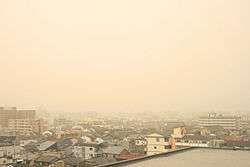
黄砂: Kyōto, spring 2010, with the skies full of yellow sand (Asian Dust).
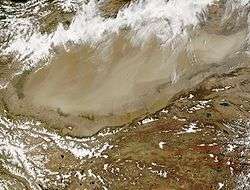
The Taklamakan Desert, source of the Asian Dust.
| Kanji in this term | |
|---|---|
| 黄 | 砂 |
| こう Grade: 2 |
さ Grade: 6 |
| on’yomi | |
From Middle Chinese compound 黃砂 (MC ɦwɑŋ ʃˠa, “yellow sand”). Compare modern Mandarin 黃砂/黄砂 (huángshā).
Kan'on reading of both characters, suggesting a later borrowing.
Pronunciation
Alternative forms
Noun
黄砂 (shinjitai kanji, kyūjitai kanji 黃砂, hiragana こうさ, rōmaji kōsa, historical hiragana くわうさ)
Synonyms
Etymology 2
| Kanji in this term | |
|---|---|
| 黄 | 砂 |
| おう Grade: 2 |
さ Grade: 6 |
| on’yomi | |
From Middle Chinese. Goon reading of first character, kan'on reading of second, suggesting an alteration in Japan after the initial borrowing.
Pronunciation
Noun
黄砂 (shinjitai kanji, kyūjitai kanji 黃砂, hiragana おうさ, rōmaji ōsa, historical hiragana わうさ) (rare)
- (see kōsa reading above)
References
This article is issued from
Wiktionary.
The text is licensed under Creative Commons - Attribution - Sharealike.
Additional terms may apply for the media files.