鋏
| ||||||||
Translingual
Han character
鋏 (radical 167 金+7, 15 strokes, cangjie input 金大人人 (CKOO), four-corner 84138, composition ⿰釒夾)
References
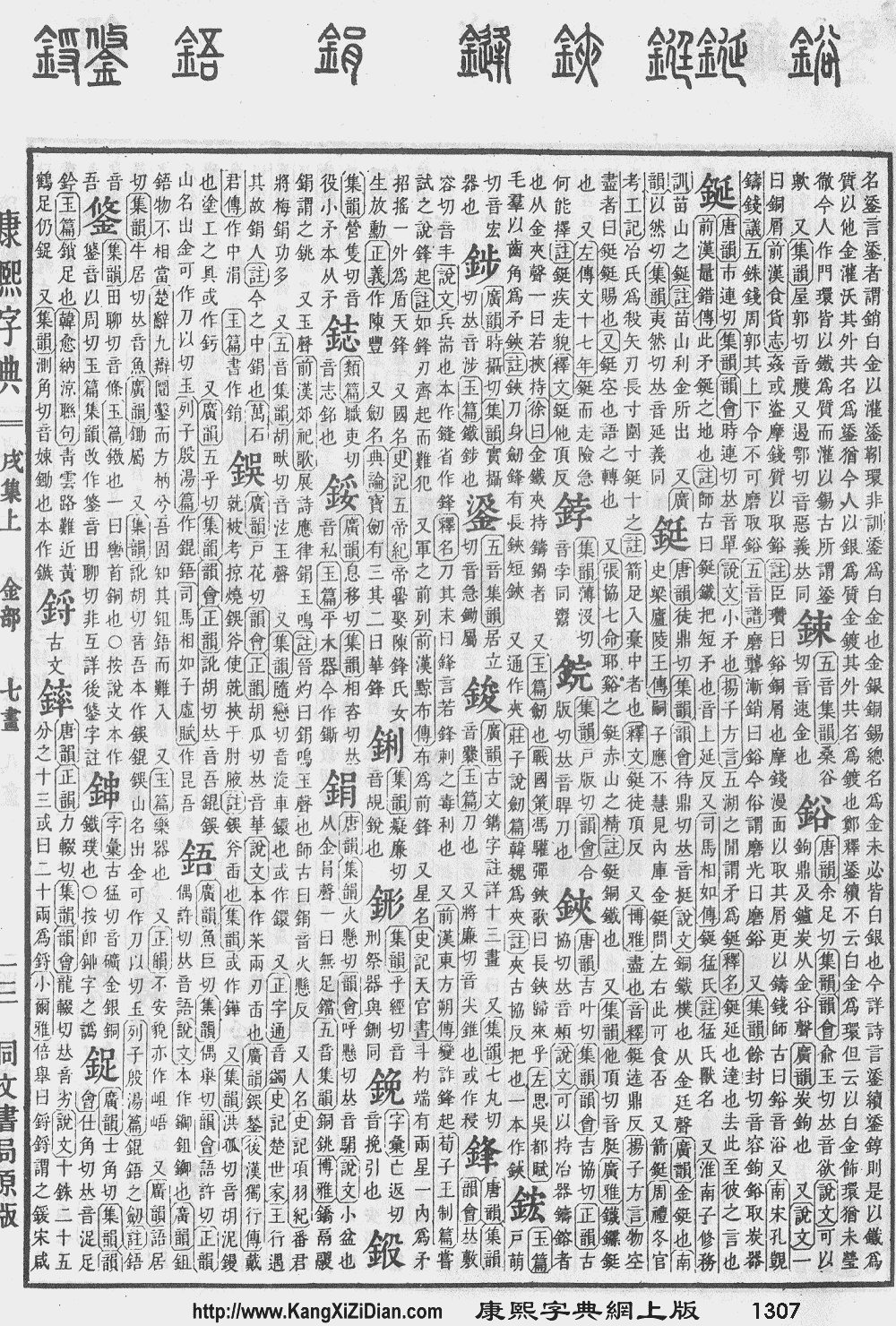
- KangXi: page 1307, character 7
- Dai Kanwa Jiten: character 40450
- Dae Jaweon: page 1809, character 13
- Hanyu Da Zidian: volume 6, page 4205, character 7
- Unihan data for U+92CF
Chinese
| trad. | 鋏 | |
|---|---|---|
| simp. | 铗 | |
Glyph origin
| Characters in the same phonetic series (夾) (Zhengzhang, 2003) | |
|---|---|
| Old Chinese | |
| 瘞 | *qrebs |
| 瘱 | *qeːbs |
| 脥 | *kʰemʔ |
| 浹 | *skaːb, *skeːb |
| 挾 | *skaːb, *ɡeːb |
| 夾 | *kreːb |
| 郟 | *kreːb |
| 筴 | *sʰreːɡ, *kreːb, *keːb |
| 裌 | *kreːb |
| 鵊 | *kreːb |
| 狹 | *ɡreːb |
| 峽 | *ɡreːb |
| 硤 | *ɡreːb |
| 陜 | *ɡreːb |
| 陿 | *ɡreːb |
| 翜 | *sraːb, *srɯːb |
| 梜 | *kraːb, *keːb |
| 頰 | *keːb |
| 莢 | *keːb |
| 鋏 | *keːb |
| 蛺 | *keːb |
| 唊 | *keːb |
| 悏 | *kʰeːb |
| 匧 | *kʰeːb |
| 愜 | *kʰeːb |
| 篋 | *kʰeːb |
| 俠 | *ɡeːb |
| 綊 | *ɡeːb |
Pronunciation
Definitions
鋏
- This term needs a translation to English. Please help out and add a translation, then remove the text
{{rfdef}}.
Compounds
Japanese
Kanji
Readings
- Goon: きょう (kyō)←けふ (kefu, historical)
- Kan’on: きょう (kyō)←けふ (kefu, historical)
- Kun: はさみ (hasami, 鋏); はさむ (hasamu, 鋏む); やとこ (yatoko, 鋏); やっとこ (yattoko, 鋏)
Etymology 1
| Kanji in this term |
|---|
| 鋏 |
| はさみ Hyōgaiji |
| kun’yomi |
Originally the 連用形 (ren'yōkei, “stem or continuative form”) of verb 鋏む (hasamu, “to be tightly between two things, to be inserted in between””),[1][2] itself apparently deriving from hasa (“narrowness between other things”, likely cognate with 細 hoso, “skinny, narrowness within the thing itself”) + auxiliary suffix む (mu, “to be or become like something”).
Cognate and homophonic with 挟, 挿 (hasami): “being stuck in between other things”.
Pronunciation
Noun
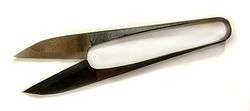
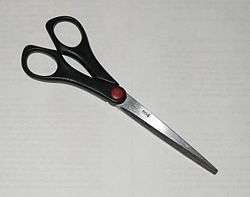
鋏 (hiragana はさみ, rōmaji hasami)
- scissors, a pair of scissors
- pincers or claws as found on a crab, lobster, or other arthropod
- a punch as used to make a hole in a piece of paper
Usage notes
The scissors and punch senses are also found spelled 剪刀.
Idioms
- 鋏を入れる (hasami o ireru): “to put the scissors in” → to cut with scissors; to punch a ticket; to trim vegetation or hair
Derived terms
- 鋏状価格差 (hasami-jō kakakusa): price scissors
- 鋏虫 (hasamimushi): an earwig
- 鋏虫目 (hasamimushi moku): order Dermaptera, the earwigs
- 鋏盤 (hasamiban): a mechanical shear for cutting metal
- 金鋏 (kanabasami): blacksmith's grippers
- 紙鋏 (kamibasami): paper scissors
- 空鋏 (karabasami): working a pair of scissors to make the sound of cutting, without actually cutting anything
- 木鋏 (kibasami): long shears for pruning, such as for a hedge
- 銀葉鋏 (gin'yō-basami): tweezers for holding silver leaf in traditional Japanese incense
- 西洋鋏 (seiyō-basami): western-style scissors
- 裁ち鋏 (tachibasami): scissors for cutting cloth
- 爪切り鋏 (tsumekiri-basami): nail clippers
- 唐鋏 (tōbasami): western-style scissors, with a pivot in the center and forming an X shape
- 握り鋏 (nigiribasami): traditional Japanese shears, with a join at the back end and forming a U shape
- 花鋏 (hanabasami): flower shears, florist's scissors
- ピンキング鋏 (pinkingu-basami): pinking shears
- 洋鋏 (yōbasami): western-style scissors
- 和鋏 (wabasami): traditional Japanese shears, with a join at the back end and forming a U shape
- 矢床鋏 (yattokobasami): blacksmith's grippers
Etymology 2
| Kanji in this term |
|---|
| 鋏 |
| やっとこ Hyōgaiji |
| kun’yomi |
Probably originally an abbreviation of synonym yattokobasami,[1] with the yattoko portion possibly an alteration of 焼き床 (yakidoko, “the cooking bed of an oven, or the firing bed of a kiln”, possibly formerly read as yakitoko, literally “burning or cooking bed”), perhaps used as a dialect word referring to the forge; compare 火床 (hidoko, “hearth; a firepit, such as beneath a boiler”, literally “fire bed”).
Pronunciation
Alternative forms
- 矢床 (ateji)
Noun
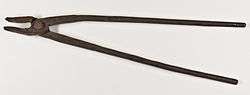
鋏 (hiragana やっとこ, rōmaji yattoko)
- pincers, nippers, pliers, tongs, or grippers, specifically those used to hold a metal object being worked in blacksmithing
Synonyms
- 矢床鋏 (yattokobasami)
Derived terms
- 矢床鋏 (yattokobasami): blacksmith's grippers
- 鋏箸 (yattokobashi): blacksmith's tongs
Further reading
- http://tool.kigasuki.com/tukamu.html -- in Japanese.
Etymology 3
| Kanji in this term |
|---|
| 鋏 |
| やとこ Hyōgaiji |
| kun’yomi |
Probable variation from yattoko. Rare.[1]
Pronunciation
Noun
鋏 (hiragana やとこ, rōmaji yatoko)
Etymology 4
| Kanji in this term |
|---|
| 鋏 |
| きょう Hyōgaiji |
| on’yomi |
/kepu/ → /keɸu/ → /keu/ → /kjoː/
From Middle Chinese 鋏 (kiɛp, “tongs, pincers”). Compare modern Cantonese reading gaap3.
Pronunciation
Affix
鋏 (hiragana きょう, rōmaji kyō, historical hiragana けふ)
Usage notes
Only found in compounds.
Derived terms
- 鋏角 (kyōkaku): chelicera, the mouthparts of certain arthropods such as spiders
- 鋏角類 (kyōkakurui): chelicerates in general
- 鋏角亜門 (kyōkaku amon): subphylum Chelicerata, comprising arachnids, sea spiders, and horseshoe crabs
References
Korean
Hanja
鋏 • (hyeop) (hangeul 협, revised hyeop, McCune–Reischauer hyŏp, Yale hyep)
- This term needs a translation to English. Please help out and add a translation, then remove the text
{{rfdef}}.