莒
| ||||||||
Translingual
Alternative forms
Due to Han unification, the traditional form containing 呂 and simplified form containing 吕 are encoded under the same code point. Depending on the font installed, this character may appear to be either 莒 or 莒.
Han character
莒 (radical 140 艸+7 in traditional Chinese and Japanese, 艸+6 in simplified Chinese, in traditional Chinese and Japanese 10 strokes, in simplified Chinese 9 strokes, cangjie input 廿口竹口 (TRHR) or 廿口口 (TRR), four-corner 44606, composition ⿱艹吕(G) or ⿱艹呂(HTJK))
Derived characters
References
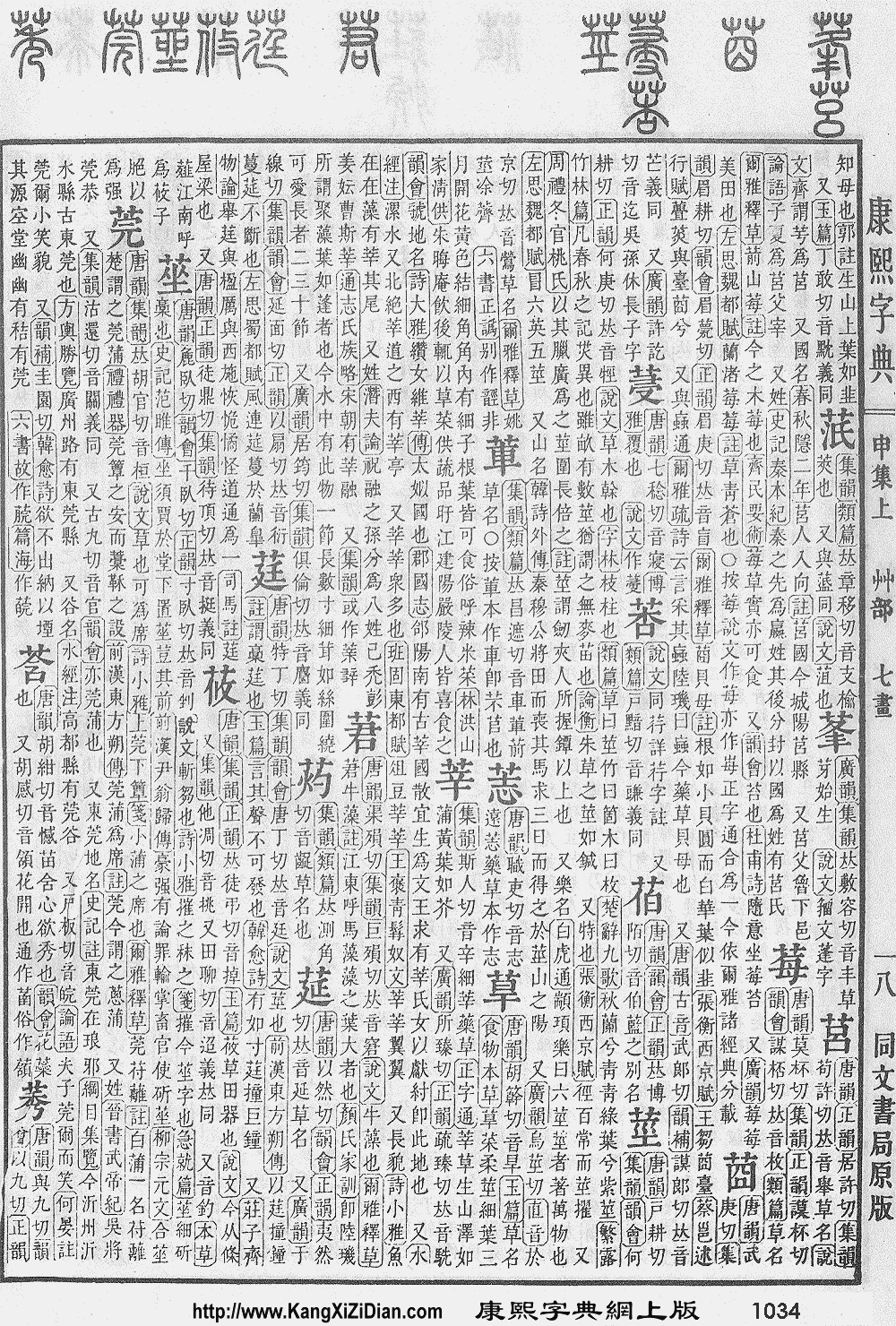
- KangXi: page 1034, character 3
- Dai Kanwa Jiten: character 31046
- Dae Jaweon: page 1493, character 8
- Hanyu Da Zidian: volume 5, page 3204, character 3
- Unihan data for U+8392
Chinese
| simp. and trad. |
莒 | |
|---|---|---|
Glyph origin
| Characters in the same phonetic series (呂) (Zhengzhang, 2003) | |
|---|---|
| Old Chinese | |
| 櫚 | *ra |
| 閭 | *ra |
| 吕 | *ɡ·raʔ |
| 侣 | *raʔ |
| 梠 | *raʔ |
| 郘 | *raʔ |
| 絽 | *raʔ |
| 莒 | *klaʔ |
| 筥 | *klaʔ |
Pronunciation
Definitions
莒
- taro
- Synonyms: 芋 (yù)
- (~國) state of Ju during the Zhou dynasty
- (~縣) Ju county in Shandong province
- A surname.
Compounds
|
|
|
Japanese
Kanji
莒
- This term needs a translation to English. Please help out and add a translation, then remove the text
{{rfdef}}.
Readings
Korean
Hanja
莒 • (geo) (hangeul 거, revised geo, McCune–Reischauer kŏ, Yale ke)
- This term needs a translation to English. Please help out and add a translation, then remove the text
{{rfdef}}.
This article is issued from
Wiktionary.
The text is licensed under Creative Commons - Attribution - Sharealike.
Additional terms may apply for the media files.