神酒
Japanese
Etymology 1
| Kanji in this term | |
|---|---|
| 神 | 酒 |
| しん Grade: 3 |
しゅ Grade: 3 |
| on’yomi | |
Possibly from Middle Chinese compound 神酒 (ʑiɪn t͡sɨuX, literally “god + wine”).
Alternatively, coined in Japan of Middle Chinese-derived elements, as a compound of 神 (shin, “god, spirit”) + 酒 (shu, “wine, liquor, alcohol”).
The individual character readings are kan'on shin + goon shu, suggesting either an innovation in the reading after borrowing, or a Japanese coinage.
Pronunciation
Noun
神酒 (hiragana しんしゅ, rōmaji shinshu)
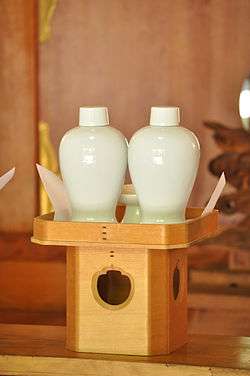
- sacramental sake used in a Shinto ceremony
- ambrosia, nectar
Synonyms
Etymology 2
| Kanji in this term | |
|---|---|
| 神 | 酒 |
| み Grade: 3 |
き Grade: 3 |
| kun’yomi | |
From Old Japanese. Appears in the Kojiki of 712 CE. Compound of 神 (mi, “honorific prefix used in spiritual contexts”) + 酒 (ki, “wine, liquor, alcohol”, ancient root, not found in many words).[1][2][3]
Pronunciation
Alternative forms
- 御酒
Noun
- sacramental sake used in a Shinto ceremony
- ambrosia, nectar
Usage notes
In Shinto contexts, often prefixed with the honorific o- as 御神酒, 大御酒 (omiki), or ō- “great” as 大神酒 (ōmiki).
Synonyms
Etymology 3
| Kanji in this term | |
|---|---|
| 神 | 酒 |
| み Grade: 3 |
わ Grade: 3 |
| Irregular | |
From Old Japanese. Appears in the Man'yōshū of 759 CE. Compound of 神 (mi, “honorific prefix used in spiritual contexts”) + わ (wa, a morpheme of uncertain derivation).[1][2][3] The final wa may be related to 泡 (awa, “bubble”) in reference to the bubbles of fermentation (compare 泡盛 (awamori, “Okinawan rice-based strong spirits”, literally “lots of bubbles”)), but this is only speculation.
Pronunciation
- (Irregular reading)
- IPA(key): [mʲiɰᵝa̠]
Alternative forms
- 御酒
Noun
- (obsolete) sacramental sake used in a Shinto ceremony
- (obsolete) ambrosia, nectar
Usage notes
The miwa reading appears to be obsolete.