果物
Japanese
Etymology 1
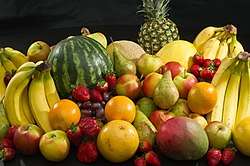
果物 (kudamono, kabutsu): various kinds of fruit.
| Kanji in this term | |
|---|---|
| 果 | 物 |
| くだ Grade: 4 |
もの Grade: 3 |
| Irregular | |
Literally “tree's thing”. Originally a compound of 木 (ku, “tree”, shift from ancient ko pronunciation) + だ (da, possessive marker between two nouns, only found in a few compounds) + 物 (mono, “thing”).[1][2]
The medial da is also seen in 獣 (kedamono, “beast”, literally “hairy thing”). The kanji is jukujikun (熟字訓).
Pronunciation
Noun
果物 (hiragana くだもの, rōmaji kudamono)
- edible fruit that grows on trees or shrubs, such as oranges and apples, or sweet edible fruit that grows along the ground, such as strawberries and melons
Synonyms
- フルーツ (furūtsu)
Derived terms
See also
- 果実 (kajitsu): fruit (edible or otherwise)
- 実 (mi): a seed, a berry, a fruit, a nut
- 青果物 (seikabutsu): garden stuff, greenstuff
- 八百屋 (yaoya): a greengrocer
Etymology 2
| Kanji in this term | |
|---|---|
| 果 | 物 |
| か Grade: 4 |
ぶつ Grade: 3 |
| on’yomi | |
/kwabut͡su/ → /kabut͡su/
Possibly from Middle Chinese compound 果物 (*guɑ *miət, literally “fruit thing”). Compare modern Mandarin 果物 reading guǒwù (rare), Cantonese gwo2 mat6 (rare).
Rarely used in modern Japanese.
Pronunciation
Noun
果物 (hiragana かぶつ, rōmaji kabutsu, historical hiragana くわぶつ)
- (rare) fruit
Usage notes
The kudamono reading is much more common in modern Japanese.
References
- The Oxford Starter Japanese Dictionary. →ISBN
This article is issued from
Wiktionary.
The text is licensed under Creative Commons - Attribution - Sharealike.
Additional terms may apply for the media files.