巫女
Chinese
| witch; Malay | female; woman; daughter | ||
|---|---|---|---|
| simp. and trad. (巫女) |
巫 | 女 | |
| anagram | 女巫 | ||
Pronunciation
Noun
巫女
Japanese
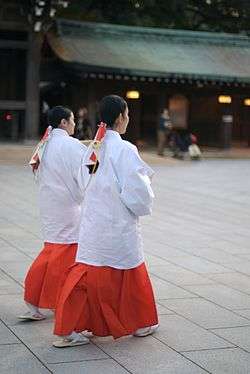
巫女 (miko): a pair of miko or shrine maidens at Meiji Jingu.
Alternative forms
Etymology 1
| Kanji in this term | |
|---|---|
| 巫 | 女 |
| Jinmeiyō | Grade: 1 |
| Irregular | |
From Old Japanese. Originally a compound of 神 (mi, “spirit, god”) + 子 (ko, “child”), as suggested by the alternative spelling 神子.
Formerly spelled as 巫 on its own.[1] The modern kanji spelling 巫女 appears to be jukujikun (熟字訓).
Pronunciation
Noun
- An unmarried woman who serves at a Shintō shrine, helping to receive visitors and performing 神楽 (kagura) dances at ceremonies, among other responsibilities. A shrine maid.
- An unmarried woman who serves a deity as a medium to convey oracles.
- 2017 April 15, “星杯を戴く巫女 [Priestess Who Drinks from the Star Chalice]”, in CODE OF THE DUELIST (in Japanese), Konami:
- 星神に鎮魂の祈りを捧げる巫女。
- Seishin ni chinkon no inori o sasageru miko.
- A priestess who offers soul-reposing prayers to the Star God.
- 星神に鎮魂の祈りを捧げる巫女。
-
Usage notes
Using the alternate spelling 神子, a miko could be of either gender, but unmarried young women are by far the most common.
Synonyms
Derived terms
Etymology 2
| Kanji in this term | |
|---|---|
| 巫 | 女 |
| ふ Jinmeiyō |
じょ Grade: 1 |
| on’yomi | |
From Middle Chinese compound 巫女 (mju? nrjoX, literally “shaman + woman”). Compare modern Mandarin reading wūnǚ.
Pronunciation
Noun
巫女 (hiragana ふじょ, rōmaji fujo, historical hiragana ふぢよ)
Synonyms
References
This article is issued from
Wiktionary.
The text is licensed under Creative Commons - Attribution - Sharealike.
Additional terms may apply for the media files.