神楽
Japanese
Etymology 1
| Kanji in this term | |
|---|---|
| 神 | 楽 |
| かむ > か Grade: 3 |
くら > ぐら Grade: 2 |
| Irregular | |
/kamukuɽa/ → /kankuɽa/ → /kanɡuɽa/ → /kaɡuɽa/
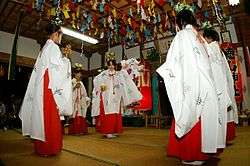
From Old Japanese: originally a compound of 神 (kamu, “spirit, god”) + 座 (kura, “seat”).[1][2][3] The kura changes to gura as an instance of rendaku (連濁). The original compound referred to the place used to call down the 神 (kami, “spirits and gods”) to earth, when a 巫女 (miko, “shrine maiden”) would act as a medium for the kami. Over time, the term came to refer to the music and dance of the ceremony. The use of the 楽 character here is an example of jukujikun (熟字訓), reflecting the change in meaning.
Pronunciation
Noun
神楽 (hiragana かぐら, rōmaji kagura)
- (Shinto) kagura (sacred dancing and music performed at Shintō ceremonies, often by miko, to honor Shintō spirits and gods)
- Synonym: 神遊び (kami asobi)
- bugaku (type of traditional dancing and music) performed by regular people in front of a Shintō shrine
- Synonyms: 里神楽 (sato kagura), 太太神楽 (daidai kagura), 太神楽 (daikagura)
- a type of Noh dancing and music
- a type of kabuki musical accompaniment
- Short for 御神楽 (okagura, “a flat-topped house initially built with one storey, with additional storeys added later”).
Derived terms
- 神楽歌 (kagura uta): a kagura song
- 神楽諷雲井曲毬 (Kagura Uta Kumoi no Kyokumari): the title of a kabuki play, roughly “Kagura Uta: Juggling to Entertain the Gods”
- 神楽男 (kagura o), 神楽男 (kagura otoko): a man who performs kagura
- 神楽岡 (Kagura Oka): Kagura Hill, a place in Kyōto, also known as Yamada Yama (Yamada Mountain) and site of Yamada Jinja (Yamada Shrine)
- 神楽月 (kagurazuki): alternate name for the eleventh lunar month
- 神楽坂 (kagurazaka): a place in the east of Shinjuku Ward, Tōkyō
- 神楽笹 (kagurazasa): alternate for 阿亀笹 (okamezasa, “Shibataea kumasaca, a type of short leafy bamboo”), or for 唐竹蘭 (tōchikuran, “a type of orchid, probably the Yunnanese spring orchid, Cymbidium goeringii subsp. goeringii var. forrestii”)
- 神楽桟, 神楽鮫 (kagurazame): the bluntnose sixgill shark, Hexanchus griseus
- 神楽山 (kagurasan): alternate name for 轆轤 (rokuro, “windlass”)
- 神楽師 (kagurashi): a professional kagura performer
- 神楽獅子 (kagurajishi): a lion dance performed as kagura; a pleasure quarter or red-light district euphemism for “hairiness”
- 神楽舎 (kagurasha): the roofed stage at a shrine or imperial palace for performing kagura
- 神楽少女 (kagura otome): alternate for 神楽巫女 (“a woman, generally unmarried, who performs kagura”)
- 神楽女 (kagurame): alternate for 神楽巫女 (“a woman, generally unmarried, who performs kagura”)
- 神楽巫女, 神楽神子 (kagura miko): a woman, generally unmarried, who performs kagura
- 神楽銭 (kagura sen): money received in thanks for a kagura performance
- 神楽草 (kagura sō): alternate name for 狐の孫 (kitsune no mago, “Justicia procumbens, also known as water willow”)
- 神楽太鼓 (kaguradaiko): a large taiko drum used in kagura performances
- 神楽笛 (kagurabue): a flute used in kagura performances
- 神楽殿 (kagura den): a building used for kagura performances
- 神楽堂 (kagura dō): a building used for kagura performances
- 神楽姫 (kagurabime): alternate for 神楽巫女 (“a woman, generally unmarried, who performs kagura”)
- 神楽面 (kagura omote): a kagura performer
- 神楽面 (kagura men): a kagura mask
- 神楽鈴 (kagura suzu): a bell used for kagura performances
- 神楽和琴秘譜 (Kagura Wagon Hifu): the title of a piece of kagura music
- 灰神楽 (haikagura): raising a cloud of ashes
Proper noun
神楽 (hiragana かぐら, rōmaji Kagura)
- A surname.
Etymology 2
| Kanji in this term | |
|---|---|
| 神 | 楽 |
| かみ Grade: 3 |
がく Grade: 2 |
| yutōyomi | |
Compound of 神 (kami, “spirit, god”) + 楽 (gaku, “music”).
Pronunciation
Noun
神楽 (hiragana かみがく, rōmaji kamigaku)
Etymology 3
| Kanji in this term | |
|---|---|
| 神 | 楽 |
| じん Grade: 3 |
らく Grade: 2 |
| on’yomi | |
Probably from Middle Chinese 神楽 (*jhin *lɑk, literally “god, spirit” + “happy; music”).
Pronunciation
Proper noun
神楽 (hiragana じんらく, rōmaji Jinraku)
- A surname.
Etymology 4
| Kanji in this term | |
|---|---|
| 神 | 楽 |
| かむ > か Grade: 3 |
らき Grade: 2 |
| Irregular | |
Unknown.
Pronunciation
- (Irregular reading)
- IPA(key): [ka̠ɾa̠kʲi]
Proper noun
神楽 (hiragana からき, rōmaji Karaki)
- A surname.