嘯
| ||||||||
Translingual
| Traditional | 嘯 |
|---|---|
| Shinjitai (extended) |
嘨 |
| Simplified | 啸 |
Han character
嘯 (radical 30, 口+12, 15 strokes, cangjie input 口中X (RLX), four-corner 65027, composition ⿰口肅)
References
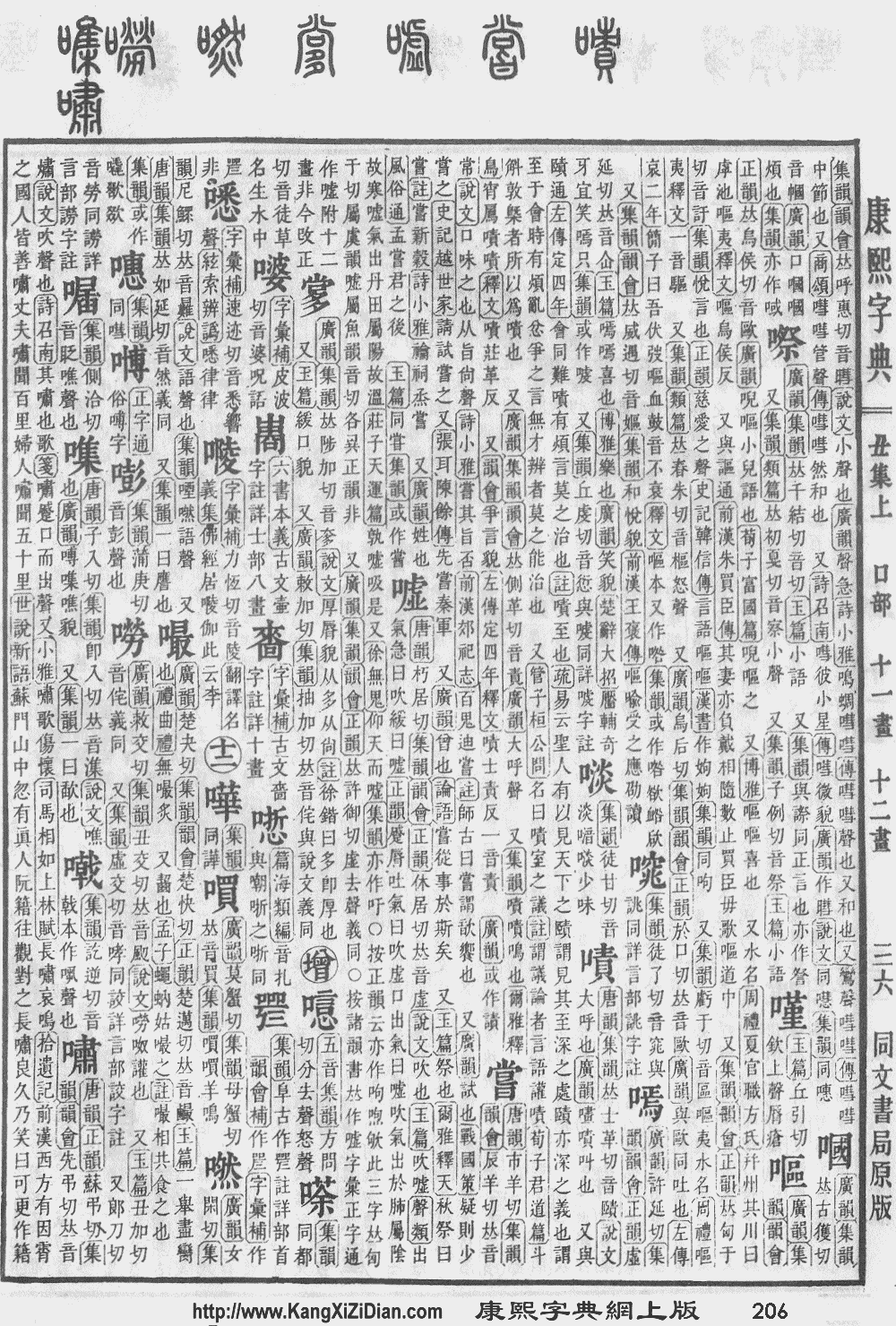
- KangXi: page 206, character 32
- Dai Kanwa Jiten: character 4246
- Dae Jaweon: page 429, character 31
- Hanyu Da Zidian: volume 1, page 694, character 11
- Unihan data for U+562F
Chinese
| trad. | 嘯 | |
|---|---|---|
| simp. | 啸 | |
| alt. forms | 嘨 | |
Glyph origin
| Characters in the same phonetic series (肅) (Zhengzhang, 2003) | |
|---|---|
| Old Chinese | |
| 簫 | *sɯːw |
| 蕭 | *sɯːw |
| 瀟 | *sɯːw |
| 潚 | *sɯːw, *sɯwɢ |
| 彇 | *sɯːw |
| 蟰 | *sɯːw, *sɯwɢ |
| 橚 | *sɯːw, *sɯwɢ |
| 嘯 | *sɯːwɢs |
| 歗 | *sɯːwɢs |
| 熽 | *sɯːwɢs |
| 繡 | *sɯwɢs |
| 鏽 | *sɯwɢs |
| 肅 | *sɯwɢ |
| 鷫 | *sɯwɢ |
| 驌 | *sɯwɢ |
| 鱐 | *sɯwɢ |
| 璛 | *sɯwɢ |
Pronunciation
Definitions
嘯
Compounds
|
Japanese
Kanji
嘯
- to whistle
Readings
Compounds
Compounds
- 嘯吹 (usofuki): the clownish “whistling” mask used in 狂言 (kyōgen, “a farce performed between noh plays”, literally “crazy talk”)
- 嘯笛 (usobue): whistling with one's mouth
- 息嘯 (okiso): a sigh
- 海嘯 (kaishō), 海嘯 (tsunami): a tsunami, a tidal wave; a tidal bore
- 吟嘯 (ginshō): to sing or chant a poem or song; to wail in grief
- 虎嘯 (koshō): a tiger's roar; (metaphor) a hero's appearance
- 嘯聚 (shōshu): calling people together (especially by whistling)
- 嘯集 (shōshū): calling people together (especially by whistling)
- 嘯風弄月 (shōfū rōgetsu): love for nature and poetry and other elegance
- 空嘯 (sorauso): absent-minded whistling
- 長嘯 (chōshō): whistling for a long time; singing or chanting for a long time
Etymology 1
From Old Japanese. Appears in poem 1753 of the Man'yōshū, a poetry compilation completed around 759 CE, in the compound form 嘯鳴 (usobuki; see below).
Pronunciation
Noun
Derived terms
Etymology 2
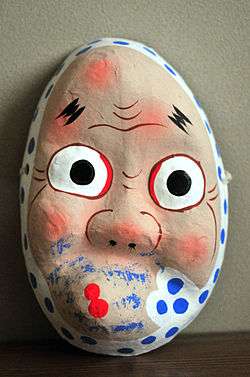
嘯 (usofuki): the “whistling” mask used in kyōgen performances.
| Kanji in this term |
|---|
| 嘯 |
| うそふ(き) Hyōgaiji |
| kun’yomi |
Compound of 嘯 (uso, “whistle, whistling”) + 吹き (fuki, “blowing”, the 連用形 (ren'yōkei, “continuative or stem form”) of verb 吹く fuku, “to blow”).[1][2]
Pronunciation
Alternative forms
- 嘯吹
Noun
嘯 (hiragana うそふき, rōmaji usofuki)
- the clownish “whistling” mask used in 狂言 (kyōgen, “a farce performed between noh plays”, literally “crazy talk”)
Synonyms
- ひょっとこ (hyottoko)
Etymology 3
| Kanji in this term |
|---|
| 嘯 |
| うそぶ(き) Hyōgaiji |
| kun’yomi |
Originally a compound of 嘯 (uso, “whistle, whistling”) + 吹き (fuki, “blowing”, the 連用形 (ren'yōkei, “continuative or stem form”) of verb 吹く fuku, “to blow”).[1][2] The fuki changes to buki as an instance of rendaku (連濁).
Pronunciation
Noun
嘯 (hiragana うそぶき, rōmaji usobuki)
Derived terms
References
Korean
Hanja
嘯 • (so) (hangeul 소, revised so, McCune–Reischauer so)
Vietnamese
Han character
嘯 (khiếu)
- This term needs a translation to English. Please help out and add a translation, then remove the text
{{rfdef}}.
This article is issued from
Wiktionary.
The text is licensed under Creative Commons - Attribution - Sharealike.
Additional terms may apply for the media files.