vaga
Catalan
Etymology
Deverbal from vagar (“to wander”).
Noun
vaga f (plural vagues)
- strike (cessation of work)
Galician
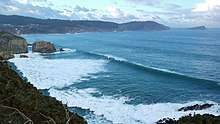
Vagas ("waves"), O Vicedo, Galicia
Etymology 1
From Old French vague, from Old Norse vágr (“sea”), from Proto-Germanic *wēgaz (“wave, storm”).[1]
Noun
vaga f (plural vagas)
- wave (sea undulation)
- Synonym: onda
- swell (a long series of ocean waves, generally produced by wind, and lasting after the wind has ceased)
- Synonym: mareira
Etymology 2
Adjective
vaga f sg
- feminine singular of vago
Verb
vaga
References
- “vaga” in Dicionario de Dicionarios da lingua galega, SLI - ILGA 2006-2013.
- “vaga” in Santamarina, Antón (coord.): Tesouro informatizado da lingua galega. Santiago de Compostela: Instituto da Lingua Galega.
- “vaga” in Álvarez, Rosario (coord.): Tesouro do léxico patrimonial galego e portugués, Santiago de Compostela: Instituto da Lingua Galega.
- ↑ Coromines, Joan; Pascual, José A. (1991–1997). Diccionario crítico etimológico castellano e hispánico. Madrid: Gredos, s.v. bogar.
Italian
Adjective
vaga f sg
- feminine singular of vago
Verb
vaga
Latin
Etymology 1
Verb
vagā
- second-person singular present active imperative of vagō
Etymology 2
Adjective
vaga
Adjective
vagā
- ablative feminine singular of vagus
Portuguese
Pronunciation
- (Portugal) IPA(key): /ˈvaɣɐ/
Noun
vaga f (plural vagas)
Adjective
vaga
- Feminine singular of adjective vago.
Verb
vaga
Scanian
Etymology
Pronunciation
- IPA(key): [ʋɑ̀ːɣa]
Verb
vaga
Serbo-Croatian
Etymology
Pronunciation
- IPA(key): /ʋǎːɡa/
- Hyphenation: va‧ga
Noun
vága f (Cyrillic spelling ва́га)
Declension
Declension of vaga
Slovene
Etymology
Borrowed from German Waage. Compare Serbo-Croatian ва́га/vága, Slovak váha, Russian вага (vaga).
Noun
vága f (genitive váge, nominative plural váge)
Spanish
Adjective
vaga f sg
- feminine singular of vago
Noun
vaga f (plural vagas, masculine vago, masculine plural vagos)
- feminine equivalent of vago
Verb
vaga
- Informal second-person singular (tú) affirmative imperative form of vagar.
- Formal second-person singular (usted) present indicative form of vagar.
- Third-person singular (él, ella, also used with usted?) present indicative form of vagar.
Swedish
Adjective
vaga
- absolute singular definite and plural form of vag.
This article is issued from
Wiktionary.
The text is licensed under Creative Commons - Attribution - Sharealike.
Additional terms may apply for the media files.