sedge
English
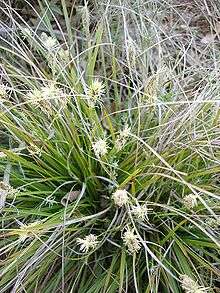
a sedge of species Carex halleriana
Pronunciation
- IPA(key): /sɛd͡ʒ/
- Rhymes: -ɛdʒ
Etymology 1
From Middle English segge, from Old English seċġ, from Proto-Germanic *sagjaz, from Proto-Indo-European *sak- (“marsh plant”). Cognate with Dutch zegge and German Segge, dialectal German Saher ‘reeds’.
Noun
sedge (plural sedges)
- Any plant of the genus Carex, the true sedges, perennial, endogenous herbs, often growing in dense tufts in marshy places. They have triangular jointless stems, a spiked inflorescence, and long grasslike leaves which are usually rough on the margins and midrib. There are several hundred species.
- 1907, Robert William Chambers, chapter VIII, in The Younger Set (Project Gutenberg; EBook #14852), New York, N.Y.: D. Appleton & Company, published 1 February 2005 (Project Gutenberg version), OCLC 24962326:
- But when the moon rose and the breeze awakened, and the sedges stirred, and the cat's-paws raced across the moonlit ponds, and the far surf off Wonder Head intoned the hymn of the four winds, the trinity, earth and sky and water, became one thunderous symphony—a harmony of sound and colour silvered to a monochrome by the moon.
-
- Any plant of the family Cyperaceae.
Derived terms
Translations
any plant of the genus Carex
any plant of the family Cyperaceae
|
See also


Etymology 2
Variant spellings.
Noun
sedge (plural sedges)
Anagrams
This article is issued from
Wiktionary.
The text is licensed under Creative Commons - Attribution - Sharealike.
Additional terms may apply for the media files.