robot
English
Etymology
From Czech robot, from robota (“drudgery, servitude”). Coined in the 1921 science-fiction play R.U.R. (Rossum's Universal Robots) by Karel Čapek after having been suggested to him by his brother Josef , and taken into English without change.
Pronunciation
Noun
robot (plural robots)
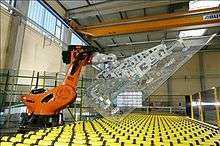
- A machine built to carry out some complex task or group of tasks by physically moving, especially one which can be programmed.
- 2010 May 16, Tim Webb, The Guardian:
- It's painfully slow and complex work which has never been attempted before in these conditions: the small box-shaped robots, equipped with two claws, are operating in almost freezing water 5,000ft below the surface, in pitch black and strong currents.
-
- (chiefly science fiction) An intelligent mechanical being designed to look like a human or other creature, and usually made from metal.
- 2010 January 26, Tom Chivers and Iain McDiarmid, The Telegraph:
- The robots in Dick's novel, loosely adapted by Ridley Scott into the film Blade Runner, were so similar to humans that when they went rogue, trained bounty hunters were called in to perform psychological tests to see whether suspected androids lacked human empathy.
-
- (figuratively) A person who does not seem to have any emotions.
- 2006, Murray N. Rothbard, Making Economic Sense, page xiv:
- Yet surely he was a humorless robot of a man, spewing forth lonely and bitter critiques of all those lesser mortals with whom he could not identify.
-
- (South Africa) A traffic light (from earlier robot policeman).
- (surveying) A theodolite which follows the movements of a prism and can be used by a one-man crew.
- A style of dance popular in disco whereby the dancer impersonates the movement of a robot
Synonyms
- See Thesaurus:robot
Hypernyms
Hyponyms
Derived terms
Translations
|
|
- The translations below need to be checked and inserted above into the appropriate translation tables, removing any numbers. Numbers do not necessarily match those in definitions. See instructions at Wiktionary:Entry layout#Translations.
|
See also
References
Anagrams
Catalan
Etymology
Noun
robot m (plural robots)
Related terms
Cebuano
Etymology
From English robot, from Czech robot, from robota (“drudgery, servitude”). Coined in the 1921 science-fiction play R.U.R. (Rossum's Universal Robots) by Karel Čapek after having been suggested to him by his brother Josef.
Pronunciation
- Hyphenation: ro‧bot
Noun
robot
- a machine built to carry out some complex task or group of tasks by physically moving, especially one which can be programmed
- an intelligent mechanical being designed to look like a human or other creature, and usually made from metal
- (figuratively) a person who does not seem to have any emotions
- a style of dance popular in disco whereby the dancer impersonates the movement of a robot
Czech
Etymology
From both the Czech and the Slovak robota. First appeared in the 1921 science-fiction play R.U.R. by Karel Čapek after having been suggested to him by his brother Josef.
Noun
robot m
Declension
Related terms
Further reading
- robot in Příruční slovník jazyka českého, 1935–1957
- robot in Slovník spisovného jazyka českého, 1960–1971, 1989
Dutch
Pronunciation
Audio (file)
Noun
Anagrams
French
Etymology
Pronunciation
- IPA(key): /ʁɔ.bo/
Audio (file)
Noun
robot m (plural robots)
Further reading
- “robot” in le Trésor de la langue française informatisé (The Digitized Treasury of the French Language).
Hungarian
Pronunciation
- IPA(key): [ˈrobot]
- Hyphenation: ro‧bot
Etymology 1
From Bavarian robat, robold, from Czech robota (“forced labour, drudgery”).
Noun
robot (plural robotok)
Declension
| Inflection (stem in -o-, back harmony) | ||
|---|---|---|
| singular | plural | |
| nominative | robot | robotok |
| accusative | robotot | robotokat |
| dative | robotnak | robotoknak |
| instrumental | robottal | robotokkal |
| causal-final | robotért | robotokért |
| translative | robottá | robotokká |
| terminative | robotig | robotokig |
| essive-formal | robotként | robotokként |
| essive-modal | — | — |
| inessive | robotban | robotokban |
| superessive | roboton | robotokon |
| adessive | robotnál | robotoknál |
| illative | robotba | robotokba |
| sublative | robotra | robotokra |
| allative | robothoz | robotokhoz |
| elative | robotból | robotokból |
| delative | robotról | robotokról |
| ablative | robottól | robotoktól |
| Possessive forms of robot | ||
|---|---|---|
| possessor | single possession | multiple possessions |
| 1st person sing. | robotom | robotjaim |
| 2nd person sing. | robotod | robotjaid |
| 3rd person sing. | robotja | robotjai |
| 1st person plural | robotunk | robotjaink |
| 2nd person plural | robototok | robotjaitok |
| 3rd person plural | robotjuk | robotjaik |
Derived terms
Etymology 2
From Czech robot, from robota (“forced labour, drudgery”). Coined in the 1921 science-fiction play R.U.R. (Rossum's Universal Robots) by Karel Čapek.
Noun
robot (plural robotok)
Declension
Same as above.
Derived terms
- robotember
- robotgép
- robotpilóta
- robotrepülőgép
Italian
Etymology
Noun
robot m (invariable)
Derived terms
Latvian
Verb
robot tr., 2nd conj., pres. roboju, robo, robo, past roboju
Conjugation
| INDICATIVE (īstenības izteiksme) | IMPERATIVE (pavēles izteiksme) | ||||
|---|---|---|---|---|---|
| Present (tagadne) |
Past (pagātne) |
Future (nākotne) | |||
| 1st pers. sg. | es | roboju | roboju | robošu | — |
| 2nd pers. sg. | tu | robo | roboji | robosi | robo |
| 3rd pers. sg. | viņš, viņa | robo | roboja | robos | lai robo |
| 1st pers. pl. | mēs | robojam | robojām | robosim | robosim |
| 2nd pers. pl. | jūs | robojat | robojāt | robosiet, robosit |
robojiet |
| 3rd pers. pl. | viņi, viņas | robo | roboja | robos | lai robo |
| RENARRATIVE (atstāstījuma izteiksme) | PARTICIPLES (divdabji) | ||||
| Present | robojot | Present Active 1 (Adj.) | robojošs | ||
| Past | esot robojis | Present Active 2 (Adv.) | robodams | ||
| Future | robošot | Present Active 3 (Adv.) | robojot | ||
| Imperative | lai robojot | Present Active 4 (Obj.) | robojam | ||
| CONDITIONAL (vēlējuma izteiksme) | Past Active | robojis | |||
| Present | robotu | Present Passive | robojams | ||
| Past | būtu robojis | Past Passive | robots | ||
| DEBITIVE (vajadzības izteiksme) | NOMINAL FORMS | ||||
| Indicative | (būt) jārobo | Infinitive (nenoteiksme) | robot | ||
| Conjunctive 1 | esot jārobo | Negative Infinitive | nerobot | ||
| Conjunctive 2 | jārobojot | Verbal noun | robošana | ||
Synonyms
- grubuļot
- izrobot
Norwegian Bokmål
Etymology
Noun
robot m (definite singular roboten, indefinite plural roboter, definite plural robotene)
- a robot
References
- “robot” in The Bokmål Dictionary.
Norwegian Nynorsk
Etymology
Noun
robot m (definite singular roboten, indefinite plural robotar, definite plural robotane)
- a robot
References
- “robot” in The Nynorsk Dictionary.
Polish
Etymology
Pronunciation
- IPA(key): /ˈrɔ.bɔt/
Noun
robot m inan
Declension
Portuguese
Noun
robot m (plural robots)
- Alternative form of robô
Serbo-Croatian
Pronunciation
- IPA(key): /rôbot/
- Hyphenation: ro‧bot
Noun
rȍbot m (Cyrillic spelling ро̏бот)
Declension
Slovene
Etymology
Pronunciation
- IPA(key): /rɔˈbóːt/
- Tonal orthography: robọ̑t
Noun
robót m anim (genitive robóta, nominative plural robóti)
Declension
Spanish
Etymology
Noun
robot m (plural robots)
Related terms
Swedish
Noun
robot c
Declension
| Declension of robot | ||||
|---|---|---|---|---|
| Singular | Plural | |||
| Indefinite | Definite | Indefinite | Definite | |
| Nominative | robot | roboten | robotar | robotarna |
| Genitive | robots | robotens | robotars | robotarnas |
Turkish
Etymology
Noun
robot (definite accusative robotu, plural robotlar)