paca
English
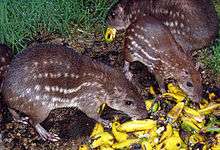
Cuniculus paca
Etymology
Pronunciation
- IPA(key): /ˈpækə/
- Rhymes: -ækə
Noun
paca (plural pacas)
- Any of the large rodents of the genus Cuniculus (but see also Cuniculus#Synonyms), native to Central America and South America, which have dark brown or black fur, a white or yellowish underbelly and rows of white spots along the sides.
Derived terms
- lowland paca (Cuniculus paca)
- mountain paca (Cuniculus taczanowskii)
Translations
rodent of genus Cuniculus
|
|
See also
- Cuniculus hernandezi
-

Anagrams
Classical Nahuatl
Pronunciation
- IPA(key): /paːka/
Verb
pāca
- (transitive) to wash
References
- Andrews, J. Richard (2003) Workbook for Introduction to Classical Nahuatl, revised edition edition, Norman: University of Oklahoma Press, page 244
- Campbell, R. Joe (1997), “Florentine Codex Vocabulary”, in (Please provide the title of the work)
- Karttunen, Francis (1983) An Analytical Dictionary of Nahuatl, Austin: University of Texas Press, page 182
- Lockhart, James (2001) Nahuatl as Written: Lessons in Older Written Nahuatl, with Copious Examples and Texts, Stanford: Stanford University Press, page 228
Esperanto
Pronunciation
- IPA(key): /ˈpat͡sa/
- Hyphenation: pa‧ca
- Rhymes: -at͡sa
Adjective
paca (accusative singular pacan, plural pacaj, accusative plural pacajn)
Derived terms
Hungarian
Pronunciation
- IPA(key): [ˈpɒt͡sɒ]
- Hyphenation: pa‧ca
Noun
paca (plural pacák)
- (colloquial) inkspot
Declension
| Inflection (stem in long/high vowel, back harmony) | ||
|---|---|---|
| singular | plural | |
| nominative | paca | pacák |
| accusative | pacát | pacákat |
| dative | pacának | pacáknak |
| instrumental | pacával | pacákkal |
| causal-final | pacáért | pacákért |
| translative | pacává | pacákká |
| terminative | pacáig | pacákig |
| essive-formal | pacaként | pacákként |
| essive-modal | — | — |
| inessive | pacában | pacákban |
| superessive | pacán | pacákon |
| adessive | pacánál | pacáknál |
| illative | pacába | pacákba |
| sublative | pacára | pacákra |
| allative | pacához | pacákhoz |
| elative | pacából | pacákból |
| delative | pacáról | pacákról |
| ablative | pacától | pacáktól |
| Possessive forms of paca | ||
|---|---|---|
| possessor | single possession | multiple possessions |
| 1st person sing. | pacám | pacáim |
| 2nd person sing. | pacád | pacáid |
| 3rd person sing. | pacája | pacái |
| 1st person plural | pacánk | pacáink |
| 2nd person plural | pacátok | pacáitok |
| 3rd person plural | pacájuk | pacáik |
Synonyms
- tintafolt
- tintapaca
Derived terms
- pacáz
- tintapaca
Irish
Alternative forms
- puca (Cois Fharraige)
Etymology
Borrowed from Middle English pakke, from Proto-Germanic *pakkô (“bundle, pack”).
Pronunciation
- IPA(key): /ˈpˠakə/
Noun
paca m (genitive singular paca, nominative plural pacaí)
- pack (bundle to be carried)
Declension
Declension of paca
Mutation
| Irish mutation | ||
|---|---|---|
| Radical | Lenition | Eclipsis |
| paca | phaca | bpaca |
| Note: Some of these forms may be hypothetical. Not every possible mutated form of every word actually occurs. | ||
Further reading
- "paca" in Foclóir Gaeilge-Béarla, An Gúm, 1977, by Niall Ó Dónaill.
- Entries containing “paca” in English-Irish Dictionary, An Gúm, 1959, by Tomás de Bhaldraithe.
- Entries containing “paca” in New English-Irish Dictionary by Foras na Gaeilge.
Italian
Etymology 1
Via Spanish paca, from Guaraní paka.
Noun
paca m (invariable)
Etymology 2
See etymology on the main entry.
Verb
paca
- third-person singular present indicative and second-person singular imperative of pacare
Anagrams
Latin
Pronunciation
- (Classical) IPA(key): /ˈpaː.kaː/
Verb
pācā
- first-person singular present active imperative of pācō
Spanish
Pronunciation
- IPA(key): /ˈpaka/
Etymology 1
Borrowed from Old French pacque.
Noun
paca f (plural pacas, masculine paco, masculine plural pacos)
- bale
- (colloquial, pejorative, Latin America) female police officer
Etymology 2
Noun
paca f (plural pacas)
- (chiefly Argentina, Paraguay and Uruguay) paca (rodent of the genus Cuniculus)
Synonyms
- boruga f (Colombian Amazonia)
- conejo pintado m (Panama)
- guagua f (Colombia)
- guanta m (Ecuador)
- guartinaja m (Northwestern Colombia)
- jochi pintado m (Bolivia)
- lapa f (Venezuela, Colombian Llanos)
- majaz m (Peru)
- tepezcuintle m, tepezcuinte m (Mexico, Central America)
- tinajo m (Northeastern Colombia)
This article is issued from
Wiktionary.
The text is licensed under Creative Commons - Attribution - Sharealike.
Additional terms may apply for the media files.