mango
English
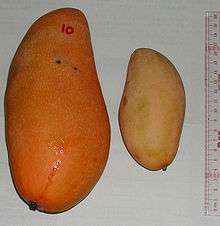
-4.jpg)
Etymology
From Portuguese manga, from Malay mangga, from Tamil மாங்காய் (māṅkāy) from மா (mā, “mango species”) + காய் (kāy, “unripe fruit”).
Pronunciation
- IPA(key): /ˈmæŋɡəʊ/
- (US) IPA(key): /ˈmæŋɡoʊ/
Audio (US) (file) - Rhymes: -æŋɡəʊ
Noun
mango (countable and uncountable, plural mangoes or mangos)
- A tropical Asian fruit tree, Mangifera indica.
- 1980, Bruce Chatwin, The Viceroy of Ouidah, page 146:
- On the hot days, he would lie in the shade of a mango and let little Eugenia clamber over his belly and tug at his beard.
- 1980, Bruce Chatwin, The Viceroy of Ouidah, page 146:
- The fruit of the mango tree.
- 1738, October–November, Hans Sloan, Philosophical Transactions, volume 40, number 450, “VI. his Answer to the Marquis de Caumont's Letter, concerning this Stone”, translated from the Latin by Thomas Stack, Royal Society (1741), page 376:
- And I have one [bezoar] form'd round the Stone of that great Plum, which comes pickled from thence, and is called Mango.
- 1738, October–November, Hans Sloan, Philosophical Transactions, volume 40, number 450, “VI. his Answer to the Marquis de Caumont's Letter, concerning this Stone”, translated from the Latin by Thomas Stack, Royal Society (1741), page 376:
- A pickled vegetable or fruit with a spicy stuffing; a vegetable or fruit which has been mangoed.
- 2004, Elizabeth E. Lea, William Woys Weaver, A Quaker Woman's Cookbook: The Domestic Cookery of Elizabeth Ellicott Lea, page 335:
- In Pennsylvania and western Maryland, mangoes were generally made with green bell peppers.
- 2004, Elizabeth E. Lea, William Woys Weaver, A Quaker Woman's Cookbook: The Domestic Cookery of Elizabeth Ellicott Lea, page 335:
- (US, chiefly southern Midwestern US, dated) A green bell pepper suitable for pickling.
- 1879, Pennsylvania State Board of Agriculture, Agriculture of Pennsylvania, page 222:
- Mango peppers by the dozen, if owned by the careful housewife, would gladden the appetite or disposition of any epicure or scold.
- 1896, Ohio State Board of Agriculture, Annual Report, page 154:
- Best mango peppers
- 2000, Allan A. Metcalf, How We Talk: American Regional English Today, page 41:
- Finally, although both the South and North Midlands are not known for their tropical climate, that's where mangoes grow. These aren't the tropical fruit, though, but what are elsewhere called green peppers.
- 1879, Pennsylvania State Board of Agriculture, Agriculture of Pennsylvania, page 222:
- A type of muskmelon, Cucumis melo.
- Any of various hummingbirds of the genus Anthracothorax.
- A yellow-orange color, like that of mango flesh.
- mango colour:
Descendants
- → Armenian: մանգո (mango) (or from Russian манго (mango))
- → Catalan: mango
- → Chichewa: bango
- → Czech: mango
- → Danish: mango
- → Dutch: mango
- → Esperanto: mango
- → Finnish: mango
- → Georgian: მანგო (mango)
- → German: Mango
- → Greek: μάνγκο (mángko)
- → Hebrew: מנגו (mango)
- → Hungarian: mangó
- → Irish: mangó
- → Japanese: マンゴー (mangō)
- → Korean: 망고 (manggo)
- → Norwegian: mango
- → Polish: mango
- → Romanian: mango
- → Russian: манго (mango)
- → Slovak: mango
- → Slovene: mango
- → Spanish: mango
- → Swedish: mango
- → Turkish: mango
Translations
|
|
|
|
|
- The translations below need to be checked and inserted above into the appropriate translation tables, removing any numbers. Numbers do not necessarily match those in definitions. See instructions at Wiktionary:Entry layout#Translations.
Verb
mango (third-person singular simple present mangoes, present participle mangoing, simple past and past participle mangoed)
- (uncommon) To stuff and pickle (a fruit).
- 1870, Hannah Mary Peterson, The Young Wife's Cook Book, page 444:
- Although any melon may be used before it is quite ripe, yet there is a particular sort for this purpose, which the gardeners know, and should be mangoed soon after they are gathered.
- 1989, William Woys Weaver, America eats: forms of edible folk art:
- In an effort to reproduce the pickle, English cooks took to "mangoing" all sorts of substitutes, from cucumbers to unripe peaches. Americans, however, preferred baby musk melons, or, in areas where they did not grow well, bell peppers.
- 2008, Beverly Ellen Schoonmaker Alfeld, Pickles To Relish →ISBN, page 66:
- For this cookbook, I made mangoed peppers that were not stuffed with cabbage, but stuffed with green and red tomatoes and onions.
- 1870, Hannah Mary Peterson, The Young Wife's Cook Book, page 444:
Translations
References
- (bell peppers): The American Midwest: An Interpretive Encyclopedia
Anagrams
Chichewa
Pronunciation
- IPA(key): /ˈma.ᵑɡó/
Noun
mangó class 6
Synonyms
Czech
Etymology
From English mango, from Portuguese manga, from Malay mangga, from Tamil மாங்காய் (māṅkāy) from மா (mā, “mango species”) + காய் (kāy, “unripe fruit”).
Pronunciation
- IPA(key): /ˈmaŋɡo/
Noun
mango n
- mango (the fruit of the mango tree)
Declension
Derived terms
|
Further reading
- mango in Příruční slovník jazyka českého, 1935–1957
- mango in Slovník spisovného jazyka českého, 1960–1971, 1989
Dutch
Etymology
From English mango, from Portuguese manga, from Malay mangga, from Tamil மாங்காய் (māṅkāy) from மா (mā, “mango species”) + காய் (kāy, “unripe fruit”).
Pronunciation
Audio (file)
Noun
mango m (plural mango's, diminutive mangootje n)
Esperanto
Etymology
From English mango, from Portuguese manga, from Malay mangga, from Tamil மாங்காய் (māṅkāy) from மா (mā, “mango species”) + காய் (kāy, “unripe fruit”).
Pronunciation
- IPA(key): /ˈmanɡo/
- Hyphenation: man‧go
Noun
mango (accusative singular mangon, plural mangoj, accusative plural mangojn)
- mango (fruit)
Derived terms
|
Finnish
Declension
| Inflection of mango (Kotus type 1/valo, no gradation) | |||
|---|---|---|---|
| nominative | mango | mangot | |
| genitive | mangon | mangojen | |
| partitive | mangoa | mangoja | |
| illative | mangoon | mangoihin | |
| singular | plural | ||
| nominative | mango | mangot | |
| accusative | nom. | mango | mangot |
| gen. | mangon | ||
| genitive | mangon | mangojen | |
| partitive | mangoa | mangoja | |
| inessive | mangossa | mangoissa | |
| elative | mangosta | mangoista | |
| illative | mangoon | mangoihin | |
| adessive | mangolla | mangoilla | |
| ablative | mangolta | mangoilta | |
| allative | mangolle | mangoille | |
| essive | mangona | mangoina | |
| translative | mangoksi | mangoiksi | |
| instructive | — | mangoin | |
| abessive | mangotta | mangoitta | |
| comitative | — | mangoineen | |
Etymology 1
Noun
mango
- mango (fruit)
Etymology 2
Noun
mango
Galician
Etymology 1
Noun
mango m (plural mangos)
Etymology 2
Verb
mango
Hiligaynon
Pronunciation
- IPA(key): /maˈŋɔʔ/
Noun
mangô
- (pejorative) Idiot.
Adjective
mangô
Usage notes
- The word can sound friendly and affectionate between close people.
See also
- banihut sutil
- lipaton
- manul
Italian
Etymology
From English mango, from Portuguese manga, from Malay mangga, from Tamil மாங்காய் (māṅkāy) from மா (mā, “mango species”) + காய் (kāy, “unripe fruit”).
Noun
mango m (plural manghi)
Anagrams
Latin
Pronunciation
- (Classical) IPA(key): /ˈman.ɡoː/, [ˈmaŋ.ɡoː]
Noun
mangō m (genitive mangōnis); third declension
Inflection
Third declension.
| Case | Singular | Plural |
|---|---|---|
| nominative | mangō | mangōnēs |
| genitive | mangōnis | mangōnum |
| dative | mangōnī | mangōnibus |
| accusative | mangōnem | mangōnēs |
| ablative | mangōne | mangōnibus |
| vocative | mangō | mangōnēs |
References
- mango in Charlton T. Lewis and Charles Short (1879) A Latin Dictionary, Oxford: Clarendon Press
- mango in Charlton T. Lewis (1891) An Elementary Latin Dictionary, New York: Harper & Brothers
- mango in Charles du Fresne du Cange’s Glossarium Mediæ et Infimæ Latinitatis (augmented edition, 1883–1887)
- mango in Gaffiot, Félix (1934) Dictionnaire Illustré Latin-Français, Hachette
- mango in Harry Thurston Peck, editor (1898) Harper's Dictionary of Classical Antiquities, New York: Harper & Brothers
Latvian
Etymology
Via other European languages, see etymology at English mango.
Pronunciation
- IPA(key): [maŋɡoː]
| (file) |
Noun
mango m (invariable)
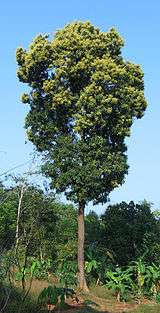
- tree of the genus Mangifera with aromatic, sweet fruits
- mango ir viens no tropu svarīgākajiem augļu kokiem ― the mango is one of the most important tropical fruit trees
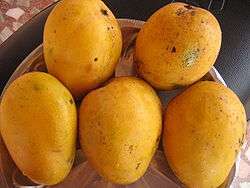
- mango fruit (the fruit of this tree)
- mango ir tropu koku augļi ― the mango is a tropical tree fruit
- mēs pasūtām mango sulu ar ledu ― we ordered mango juice with ice
Polish
Etymology
From English mango, from Portuguese manga, from Malay mangga, from Tamil மாங்காய் (māṅkāy) from மா (mā, “mango species”) + காய் (kāy, “unripe fruit”).
Pronunciation
- IPA(key): /ˈman.ɡɔ/
Audio (file)
Noun
mango n (indeclinable)
- mango (fruit and tree)
Spanish
Pronunciation
- IPA(key): /ˈmanɡo/, [ˈmãŋɡo]
Etymology 1
From Vulgar Latin manicus, from Latin manus (“hand”).
Noun
mango m (plural mangos)
See also
Etymology 2
From English mango, from Portuguese manga, from Malay mangga, from Tamil மாங்காய் (māṅkāy) from மா (mā, “mango species”) + காய் (kāy, “unripe fruit”).
Noun
mango m (plural mangos)
- (botany) mango
- (Argentina, Uruguay, lunfardo, colloquial) cash, dough (money)
- 1930, Enrique Santos Discépolo (lyrics), “Yira, Yira”, performed by Carlos Gardel:
- Buscando ese mango / Que te haga morfar...
- Looking for that money / That lets you eat...
- Buscando ese mango / Que te haga morfar...
-
Etymology 3
Verb
mango
Further reading
- “mango” in Diccionario de la lengua española, Vigésima tercera edición, Real Academia Española, 2014.