loge
English
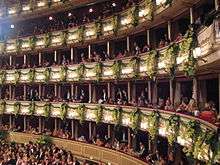
Loges in an opera house.
Etymology
From French loge (“arbor, covered walk-way”) from Frankish *laubija (“shelter”). Akin to Old High German. loub (“porch, gallery”) (German Laube (“bower, arbor”)), Old High German. loub (“leaf, foliage”), Old English lēaf (“leaf, foliage”). More at lobby, loggia, leaf, lodge.
Pronunciation
- IPA(key): /ləʊʒ/
- Rhymes: -əʊʒ
Noun
loge (plural loges)
- A booth or stall.
- The lodge of a concierge.
- 1936, Djuna Barnes, Nightwood, Faber & Faber 2007, p. 70:
- About three in the morning, Nora knocked at the little glass door of the concierge's loge, asking if the doctor was in.
- 1936, Djuna Barnes, Nightwood, Faber & Faber 2007, p. 70:
- An upscale seating region in a modern concert hall or sports venue, often in the back lower tier, or on a separate tier above the mezzanine.
- An exclusive box or seating region in older theaters and opera houses, having wider, softer, and more widely spaced seats than in the gallery.
-
- Patte notes that the spectators who were seated there were too close to the action to frame it as real, and that the loges in the avant-scène hampered the effect of the voice.
-
Translations
booth — see booth
stall — see stall
Anagrams
Dutch
Pronunciation
Audio (file)
Etymology 1
Noun
loge f (plural loges, diminutive logetje n)
- (theater) box, compartment.
- (freemasonry) Masonic lodge.
- reception area, lobby (of a hotel for instance).
Synonyms
- (Masonic lodge):
- tempel
- werkplaats
- (reception area):
- receptie
Hyponyms
- (theater box):
- engelenbak
- skybox
Etymology 2
Verb
loge
- (archaic) singular past subjunctive of liegen
Etymology 3
Verb
loge
- (archaic) singular present subjunctive of logen
French
Etymology
Old French, from Frankish *laubja, related to Old High German louppea, from Proto-Germanic *laubja, probably from Proto-Indo-European *leubʰ- (“peel, strip, break off”). The Masonic sense developed under influence from English lodge.
Pronunciation
- IPA(key): /lɔʒ/
Noun
loge f (plural loges)
Related terms
Verb
loge
Further reading
- “loge” in le Trésor de la langue française informatisé (The Digitized Treasury of the French Language).
Middle French
Etymology
Old French, from Frankish *laubja.
Noun
loge f (plural loges)
- hut (small often wooden building)
Verb
loge
- first-person singular present indicative of loger, logier
- third-person singular present indicative of loger, logier
- first-person singular present subjunctive of loger, logier
- third-person singular present subjunctive of loger, logier
- second-person singular imperative of loger, logier
Descendants
References
- loge on Dictionnaire du Moyen Français (1330-1500) (in French)
Norwegian Nynorsk
Verb
loge
Swedish
Etymology 1
From French.
Pronunciation
- IPA(key): /loːɧ/
Noun
loge ?
- A backstage dressing room for actors at a theatre.
- A private seating chamber at a theatre.
- A section or local chapter of an order (for instance freemasons).
Declension
| Declension of loge | ||||
|---|---|---|---|---|
| Singular | Plural | |||
| Indefinite | Definite | Indefinite | Definite | |
| Nominative | loge | logen | loger | logerna |
| Genitive | loges | logens | logers | logernas |
Etymology 2
Pronunciation
- IPA(key): /ˈluːˌɡɛ/
Noun
loge ?
- A barn with a strong and flat wooden floor, suitable for threshing or dancing.
Declension
| Declension of loge | ||||
|---|---|---|---|---|
| Singular | Plural | |||
| Indefinite | Definite | Indefinite | Definite | |
| Nominative | loge | logen | logar | logarna |
| Genitive | loges | logens | logars | logarnas |
Etymology 3
See le (“smile”)
Pronunciation
- IPA(key): /ˈluːˌɡɛ/
Verb
loge
- subjunctive of le.
Volapük
Noun
loge
- dative singular of log
This article is issued from
Wiktionary.
The text is licensed under Creative Commons - Attribution - Sharealike.
Additional terms may apply for the media files.