liver
See also: Liver
English
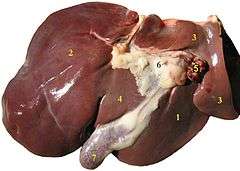
Sheep's liver
Etymology 1
From Middle English, from Old English lifer, from Proto-Germanic *librō. Cognate with Dutch lever, German Leber, Danish, Norwegian and Swedish lever (the last three from Old Norse lifr).
Pronunciation
- IPA(key): /lɪvə(ɹ)/
Audio (US) (file) - Rhymes: -ɪvə(ɹ)
Noun
liver (countable and uncountable, plural livers)
- (anatomy) A large organ in the body that stores and metabolizes nutrients, destroys toxins and produces bile. It is responsible for thousands of biochemical reactions.
- Steve Jobs is a famous liver transplant recipient.
- (countable, uncountable) This organ, as taken from animals used as food.
- I'd like some goose liver pate.
- You could fry up some chicken livers for a tasty treat. — Nah, I don't like chicken liver.
- 1993, Philippa Gregory, Fallen Skies, →ISBN, page 222:
- "I should think you've rocked the boat enough already by refusing to eat liver."
- A dark brown colour, tinted with red and gray, like the colour of liver.
- liver colour:
Usage notes
- The noun is often used attributively to modify other words. Used in this way, it frequently means "concerning the liver", "intended for the liver" or "made of liver" .
Derived terms
Terms derived from liver
|
Translations
organ of the body
|
|
organ as food
|
|
colour
|
Adjective
liver (not comparable)
- Of the colour of liver (dark brown, tinted with red and gray).
- 2006, Rawdon Briggs Lee, A History and Description of the Modern Dogs of Great Britain & Ireland, →ISBN, page 298:
- His friend Rothwell, who had the use of the best Laveracks for breeding purposes, wrote him that one of his puppies was liver and white.
- 2006, Rawdon Briggs Lee, A History and Description of the Modern Dogs of Great Britain & Ireland, →ISBN, page 298:
Translations
colour
|
|
See also
- detoxification
- fascioliasis
- gout
- jaundice
- Appendix:Colors
- foie gras
- heparin
- hepatic
Etymology 2
Pronunciation
- IPA(key): /lɪvə(ɹ)/
Audio (US) (file) - Rhymes: -ɪvə(ɹ)
Noun
liver (plural livers)
- Someone who lives (usually in a specified way).
- 1603, John Florio, transl.; Michel de Montaigne, The Essayes, […], printed at London: […] Edward Blount […], OCLC 946730821:, II.31:
- Ephori of Sparta, hearing a dissolute liver propose a very beneficial advise unto the people, commaunded him to hold his peace, and desired an honest man to assume the invention of it unto himselfe and to propound it.
- 1621, Democritus Junior [pseudonym; Robert Burton], The Anatomy of Melancholy, Oxford: Printed by Iohn Lichfield and Iames Short, for Henry Cripps, OCLC 216894069; The Anatomy of Melancholy: […], 2nd corrected and augmented edition, Oxford: Printed by John Lichfield and James Short, for Henry Cripps, 1624, OCLC 54573970, (please specify |partition=1, 2, or 3):, II.3.7:
- a wicked liver may be reclaimed, and prove an honest man […].
- Prior
- Try if life be worth the liver's care.
-
Quotations
- For quotations of use of this term, see Citations:liver.
Translations
Etymology 3
Pronunciation
- IPA(key): /laɪvə(ɹ)/
- Rhymes: -aɪvə(ɹ)
Adjective
liver
Further reading

Anagrams
Breton
Noun
liver m
Norwegian Nynorsk
Verb
liver
- (non-standard since 1917) present tense of liva
This article is issued from
Wiktionary.
The text is licensed under Creative Commons - Attribution - Sharealike.
Additional terms may apply for the media files.