kerf
See also: Kerf
English
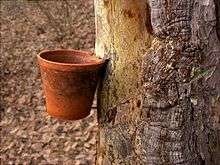
Collecting resin: a pot pitched between a nail and a kerf in a tree.
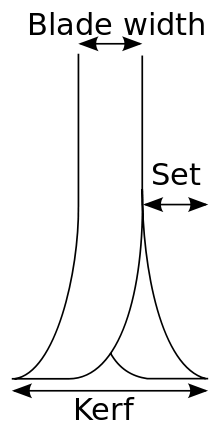
A schematic drawing of a saw blade looking head-on: the divergence between the teeth that protrude left-and-right is the kerf, it defines the width of the saw cut.
Etymology
From Middle English kerf, kirf, kyrf, from Old English cyrf (“an act of cutting, a cutting off; a cutting instrument”), from Proto-Germanic *kurbiz (“a cut; notch”), from Proto-Indo-European *gerbʰ- (“to scratch”).
Pronunciation
- IPA(key): /kɜːf/
Audio (US) (file) - Rhymes: -ɜː(ɹ)f
Noun
kerf (plural kerfs)
- The groove or slit created by cutting a workpiece; an incision.
- 1999, Neal Stephenson, Cryptonomicon:
- They pass through a cleft that has been made across a low range of hills, like a kerf in the top of a log, and enter into a lovely territory of subtly swelling emerald green fields strewn randomly with small white capsules that he takes to be sheep.
-
- The width of the groove made while cutting with a saw or laser.
- 1991, Popular Mechanics, January issue, page 63, "Thin-kerf blades", by Rosario Capotostro
- Sawing with a thin-kerf blade produces a kerf that's 1/2 to 1/3 the size of a standard blade kerf.
- 1991, Popular Mechanics, January issue, page 63, "Thin-kerf blades", by Rosario Capotostro
- The distance between diverging saw teeth.
- The portion of hay, turf, wool, etc. yielded by a single cut or shearing stroke.
Related terms
Translations
the groove or slit cut in the workpiece
Verb
kerf (third-person singular simple present kerfs, present participle kerfing, simple past and past participle kerfed)
- To cut a piece of wood or other material with several kerfs to allow it to be bent.
References
- kerf in The Century Dictionary, The Century Co., New York, 1911 (Supplement)
Anagrams
Dutch
Pronunciation
Audio (file)
Verb
kerf
This article is issued from
Wiktionary.
The text is licensed under Creative Commons - Attribution - Sharealike.
Additional terms may apply for the media files.