wool
See also: Wool
English
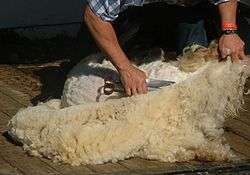
A sheep being sheared for its wool.
Etymology
From Middle English wolle, from Old English wull, from Proto-Germanic *wullō (cognate with Saterland Frisian Wulle, German Low German Wull, Dutch wol, German Wolle, Norwegian ull), from Proto-Indo-European *h₂wĺ̥h₁neh₂ (compare Welsh gwlân, Latin lāna, Lithuanian vìlna, Russian во́лос (vólos), Balau влас, Albanian lesh (“wool, hair, fleece”)).
Pronunciation
Noun
wool (usually uncountable, plural wools)
- The hair of the sheep, llama and some other ruminants.
- 2006, Nigel Guy Wilson, Ancient Greece, page 692
- The sheep were caught and plucked, because shears had not yet been invented to cut the wool from the sheep's back.
- 2006, Nigel Guy Wilson, Ancient Greece, page 692
- A cloth or yarn made from the wool of sheep.
- 2009, January 12, “Mireya Navarro”, in It May Market Organic Alternatives, but Is Your Cleaner Really Greener?:
- Spielvogel said wet cleaning also has limitations; while it is fine for cottons and fabrics worn in warm climates, he said, it can damage heavy wools or structured clothes like suit jackets.
-
- Anything with a texture like that of wool.
- 1975, Anthony Julian Huxley, Plant and Planet, page 223
- The groundsels have leaves covered in wool for insulation […]
- 1975, Anthony Julian Huxley, Plant and Planet, page 223
- A fine fiber obtained from the leaves of certain trees, such as firs and pines.
- (obsolete) Short, thick hair, especially when crisped or curled.
- Shakespeare
- wool of bat and tongue of dog
- Shakespeare
- (Britain, New Zealand) yarn (including that which is made from synthetic fibers.)
Hyponyms
Coordinate terms
Derived terms
Terms derived from wool
|
|
|
Translations
hair of sheep, etc.
|
|
cloth or yarn
|
|
See also

Cornish
Noun
wool
- Soft mutation of gool.
This article is issued from
Wiktionary.
The text is licensed under Creative Commons - Attribution - Sharealike.
Additional terms may apply for the media files.