faca
Galician
Pronunciation
- IPA(key): /ˈfaka̝/
Etymology 1
Unknown. Probably not from Latin falx, from which originates fouce (“sickle”).[1]
Noun
faca f (plural facas)
- a large pocketknife
Etymology 2
From Old French haque, from Middle English hack, from Hackney, a borough of London famous for its horses. Cognate with Spanish jaca.
Noun
faca f (plural facas)
- a mare
- 1455, X. Ferro Couselo (ed.), A vida e a fala dos devanceiros, Vigo: Galaxia, page 316:
- Iten, que furtara a faqa a Pero Gayo da sua casa, que está á par da vila de Ribadauia, da casa que está á par da ponte, et que lla furtara con a sella e con o freo et que fora despois por ela preso ena Cruña
- Item, that he stole the mare of Pedro Gaio, from his house that is near the town of Ribadavia, by the bridge; and that he stole her with saddle and bridle, and that later he was captured because of her in A Coruña
- Iten, que furtara a faqa a Pero Gayo da sua casa, que está á par da vila de Ribadauia, da casa que está á par da ponte, et que lla furtara con a sella e con o freo et que fora despois por ela preso ena Cruña
- 1455, X. Ferro Couselo (ed.), A vida e a fala dos devanceiros, Vigo: Galaxia, page 316:
References
- “faca” in Dicionario de Dicionarios do galego medieval, SLI - ILGA 2006-2012.
- “faqa” in Xavier Varela Barreiro & Xavier Gómez Guinovart: Corpus Xelmírez - Corpus lingüístico da Galicia medieval. SLI / Grupo TALG / ILG, 2006-2016.
- “faca” in Dicionario de Dicionarios da lingua galega, SLI - ILGA 2006-2013.
- “faca” in Santamarina, Antón (coord.): Tesouro informatizado da lingua galega. Santiago de Compostela: Instituto da Lingua Galega.
- “faca” in Álvarez, Rosario (coord.): Tesouro do léxico patrimonial galego e portugués, Santiago de Compostela: Instituto da Lingua Galega.
- ↑ Cf. Coromines, Joan; Pascual, José A. (1991–1997). Diccionario crítico etimológico castellano e hispánico. Madrid: Gredos, s.v. faca.
Irish
Pronunciation
- IPA(key): /ˈfˠakə/
Verb
faca
- past indicative dependent analytic of feic
- Ceapaim go bhfaca sé an madra.
- I think that he saw the dog.
Usage notes
- Always occurs either lenited or eclipsed depending on the preverbal particle:
- Ní fhaca mé. ― I didn’t see.
- an áit a bhfaca mé an buachaill inti ― the place where I saw the boy
- Takes the forms of preverbal particles normally associated with the present tense, such as go, an, and nach, rather than gur, ar, and nár:
- An bhfaca tú? ― Did you see?
- Nach bhfaca tú? ― Didn’t you see?
Mutation
| Irish mutation | ||
|---|---|---|
| Radical | Lenition | Eclipsis |
| faca | fhaca | bhfaca |
| Note: Some of these forms may be hypothetical. Not every possible mutated form of every word actually occurs. | ||
Further reading
- "faca" in Foclóir Gaeilge-Béarla, An Gúm, 1977, by Niall Ó Dónaill.
- Entries containing “fhaca” in English-Irish Dictionary, An Gúm, 1959, by Tomás de Bhaldraithe.
- Entries containing “fhaca” in New English-Irish Dictionary by Foras na Gaeilge.
Portuguese
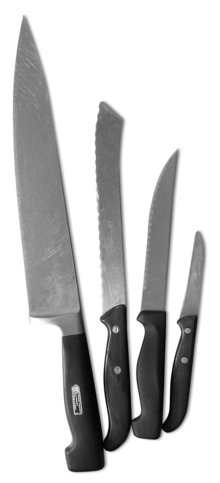
facas
Etymology
Pronunciation
Noun
faca f (plural facas)
Derived terms
Scottish Gaelic
Etymology
Verb
faca
- past dependent of faic
Mutation
| Scottish Gaelic mutation | |
|---|---|
| Radical | Lenition |
| faca | fhaca |
| Note: Some of these forms may be hypothetical. Not every possible mutated form of every word actually occurs. | |
Serbo-Croatian
Etymology
Noun
faca f (Cyrillic spelling фаца)
Spanish
Verb
faca
- This term needs a translation to English. Please help out and add a translation, then remove the text
{{rfdef}}.
This article is issued from
Wiktionary.
The text is licensed under Creative Commons - Attribution - Sharealike.
Additional terms may apply for the media files.