ebur
Latin
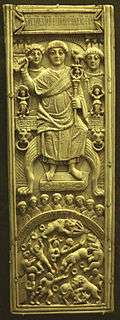
ebur Bȳzantīnum (a Byzantine ivory)
Alternative forms
Etymology
Loan word, probably from Egyptian ꜣbw:
|


but also note Sanskrit इभ (íbha). In any case, probably cognate with Ancient Greek ἐλέφας (eléphas, “elephant”)
Pronunciation
- (Classical) IPA(key): /ˈe.bur/, [ˈɛ.bʊr]
-
Audio (Classical) (file)
Noun
ebur n (genitive eboris); third declension
Declension
Third declension neuter.
| Case | Singular | Plural |
|---|---|---|
| nominative | ebur | ebora |
| genitive | eboris | eborum |
| dative | eborī | eboribus |
| accusative | ebur | ebora |
| ablative | ebore | eboribus |
| vocative | ebur | ebora |
Synonyms
- (elephant): elephantus, elephās
Derived terms
Descendants
References
- ĕbur in Charlton T. Lewis and Charles Short (1879) A Latin Dictionary, Oxford: Clarendon Press
- ebur in Charlton T. Lewis (1891) An Elementary Latin Dictionary, New York: Harper & Brothers
- ĕbŭr in Gaffiot, Félix (1934) Dictionnaire Illustré Latin-Français, Hachette, page 568/3
- ebur in Harry Thurston Peck, editor (1898) Harper's Dictionary of Classical Antiquities, New York: Harper & Brothers
- ebur in William Smith et al., editor (1890) A Dictionary of Greek and Roman Antiquities, London: William Wayte. G. E. Marindin
- “ebur” on pages 583–4 of the Oxford Latin Dictionary (1st ed., 1968–82)
Meriam
Noun
ebur
Old High German
Etymology
From Proto-Germanic *eburaz. Cognates include Old English eofor, Old Norse jǫfurr.
Noun
ebur m
Declension
Descendants
This article is issued from
Wiktionary.
The text is licensed under Creative Commons - Attribution - Sharealike.
Additional terms may apply for the media files.