desa
Catalan
Verb
desa
- third-person singular present indicative form of desar
- second-person singular imperative form of desar
Indonesian
Etymology
Noun
desa
Latvian
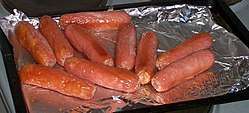
Desas
Etymology
From Proto-Baltic *deš-, from Proto-Indo-European *deḱ- (“to cut, to sever, to split into fibers”). A minority opinion derives desa from a different stem *deḱ- (“to remove, to take out”). Cognates include Lithuanian dešrà, dialectal dešerà, Gothic 𐍄𐌰𐌲𐌻 (tagl, “hair”), Old Norse tagl (“horsehair”), Old High German zagal (“tail, rod”), Old English tægl, tægel (“tail”), English tail, Sanskrit देशा (deśā, “fringe of cloth; lamp wick”).[1]
Pronunciation
- IPA(key): [dæsa]
| (file) |
Noun
desa f (4th declension)
- sausage (meat product made of ground meat and seasonings stuffed into an animal's intestine or some similar cylindrical material)
Declension
Declension of desa (4th declension)
Derived terms
- (dated) desinieks, desiniece
- (colloquial) desot
- (colloquial) muļķadesa, muļķa desa
References
- ↑ Karulis, Konstantīns (1992), “desa”, in Latviešu Etimoloģijas Vārdnīca (in Latvian), Rīga: AVOTS, →ISBN
Malay
Etymology
Noun
desa (plural desa-desa)
Pali
Alternative forms
Etymology
Noun
desa ?
Spanish
Etymology
Contraction
desa
Related terms
This article is issued from
Wiktionary.
The text is licensed under Creative Commons - Attribution - Sharealike.
Additional terms may apply for the media files.