canon
English
Etymology 1
Borrowed from Old French canon, from Latin canōn, from Ancient Greek κανών (kanṓn, “measuring rod, standard”), akin to κάννα (kánna, “reed”), perhaps from Semitic (compare Hebrew קָנֶה (qane, “reed”)). See also cane.
Pronunciation
- IPA(key): /ˈkæn.ən/
- Rhymes: -ænən
- Homophone: cannon
Noun
canon (plural canons)
- A generally accepted principle; a rule.
- The trial must proceed according to the canons of law.
- Shakespeare
- Or that the Everlasting had not fixed His canon 'gainst self-slaughter.
- A group of literary works that are generally accepted as representing a field.
- (Can we date this quote?) "the durable canon of American short fiction" — William Styron
- The works of a writer that have been accepted as authentic.
- the entire Shakespeare canon
- A eucharistic prayer, particularly the Roman Canon.
- A religious law or body of law decreed by the church.
- We must proceed according to canon law.
- A catalogue of saints acknowledged and canonized in the Roman Catholic Church.
- In monasteries, a book containing the rules of a religious order.
- A member of a cathedral chapter; one who possesses a prebend in a cathedral or collegiate church.
- A piece of music in which the same melody is played by different voices, but beginning at different times; a round.
- Pachelbel’s Canon has become very popular.
- (Roman law) A rent or stipend payable at some regular time, generally annual, e.g., canon frumentarius
- 1919 January 1, Charles P. Sherman, “A Brief History of Imperial Roman Canon Law”, in California Law Review, volume 7, number 2, Berkeley, California: University of California, pages 96-97:
- The lessees of public lands had to pay a perpetual rent or "canon" at some periodical time.
-
- (fandom) Those sources, especially including literary works, which are generally considered authoritative regarding a given fictional universe.
- A spin-off book series revealed the aliens to be originally from Earth, but it's not canon.
- 2014, Phineas and Ferb: Star Wars
- Meanwhile, having learned the whereabouts of the Death Star's plans, the rebels send their best platypus agent to obtain them, in hopes of finding a weakness. And none of this is canon, so just relax.
- (cooking) A rolled and filleted loin of meat; also called cannon.
- a canon of beef or lamb
- (printing, dated) A large size of type formerly used for printing the church canons, standardized as 48-point.
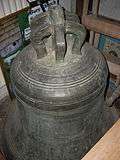
- The part of a bell by which it is suspended; the ear or shank of a bell.
- (Can we find and add a quotation of Knight to this entry?)
- (billiards) A carom.
Synonyms
- (48-point type): French canon
Derived terms
Translations
|
Etymology 2
From Middle English canoun, ultimately from Latin canonicus (either by shortening or back-formation from Old English canonic, or via Anglo-Norman chanoine).
Noun
canon (plural canons)
- A clergy member serving a cathedral or collegiate church.
- A canon regular, a member of any of several Roman Catholic religious orders.
Translations
Etymology 3
Noun
canon (plural canons)
- Alternative spelling of qanun
Anagrams
Dutch
Etymology
From Ancient Greek κανών (kanṓn, “measuring rod, standard”), akin to κάννα (kánna, “reed”), perhaps from Semitic (compare Hebrew קנה (qaneh, “reed”)).
Pronunciation
- IPA(key): /ˈkaː.nɔn/
Audio (file) - Rhymes: -anɔn
- Hyphenation: ca‧non
Noun
canon m (plural canons, diminutive canonnetje n)
- canon (principle, literary works, prayer, religious law, music piece)
Derived terms
- canoniek
- canoniseren
French
Pronunciation
- IPA(key): /ka.nɔ̃/
audio (file)
Etymology 1
From Old French canon, from canne + -on, corresponding to Italian cannone.
Noun
canon m (plural canons)
Etymology 2
From the above noun by conversion.
Adjective
canon (plural canons)
Etymology 3
From Old French canon, borrowed from Latin canōn, from Ancient Greek κανών (kanṓn, “measuring rod, standard”).
Noun
canon m (plural canons)
Etymology 4
Noun
canon m (plural canons)
Further reading
- “canon” in le Trésor de la langue française informatisé (The Digitized Treasury of the French Language).
Latin
Etymology
Borrowed from Ancient Greek κανών (kanṓn, “measuring rod, standard”), akin to κάννα (kánna, “reed”), perhaps from Semitic (compare Hebrew קנה (qaneh, “reed”)).
Pronunciation
- (Classical) IPA(key): /ˈka.noːn/
Noun
canōn m (genitive canonis); third declension
- a measuring line
- (figuratively) precept, rule, canon
- (Ecclesiastical Latin) catalog of sacred writings
- (Later Latin) a cannon (artillery)
- a yearly tribute paid to the emperor
Inflection
Third declension.
| Case | Singular | Plural |
|---|---|---|
| nominative | canōn | canonēs |
| genitive | canonis | canonum |
| dative | canonī | canonibus |
| accusative | canonem | canonēs |
| ablative | canone | canonibus |
| vocative | canōn | canonēs |
Synonyms
- (precept, rule): nōrma, praeceptum, rēgula
Descendants
References
- canon in Charlton T. Lewis and Charles Short (1879) A Latin Dictionary, Oxford: Clarendon Press
- canon in Charles du Fresne du Cange’s Glossarium Mediæ et Infimæ Latinitatis (augmented edition, 1883–1887)
- canon in Gaffiot, Félix (1934) Dictionnaire Illustré Latin-Français, Hachette
- canon in Harry Thurston Peck, editor (1898) Harper's Dictionary of Classical Antiquities, New York: Harper & Brothers
- canon in William Smith et al., editor (1890) A Dictionary of Greek and Roman Antiquities, London: William Wayte. G. E. Marindin
Norman
Etymology
From Old French canon.
Noun
canon m (plural canons)
Old French
Etymology 1
Noun
canon m (oblique plural canons, nominative singular canons, nominative plural canon)
Etymology 2
Borrowed from Latin canōn, from Ancient Greek κανών (kanṓn, “measuring rod, standard”).
Descendants
Romanian
Etymology
Borrowed from Greek κανών (kanón), possibly partly through a South Slavic language intermediate.
Noun
canon n (plural canoane)
- canon
- (usually in regards to religion) tenet, dogma, rule, norm, precept
- punishment or penance for breaking such a religious rule
Declension
| singular | plural | |||
|---|---|---|---|---|
| indefinite articulation | definite articulation | indefinite articulation | definite articulation | |
| nominative/accusative | (un) canon | canonul | (niște) canoane | canoanele |
| genitive/dative | (unui) canon | canonului | (unor) canoane | canoanelor |
| vocative | canonule | canoanelor | ||
Derived terms
Spanish
Etymology
Borrowed from Latin canōn[1], from Ancient Greek κανών (kanṓn, “measuring rod, standard”) (compare κάννα (kánna, “reed”)), perhaps of Semitic origin.
Pronunciation
- IPA(key): /ˈkanon/, [ˈkanõn]
Noun
canon m (plural cánones)
- canon (principle, literary works, prayer, religious law, music piece)
Synonyms
Related terms
References
Further reading
- “canon” in Diccionario de la lengua española, Vigésima tercera edición, Real Academia Española, 2014.
Welsh
Alternative forms
- canasom (literary, first-person plural)
- canasant (literary, third-person plural)
Pronunciation
- (North Wales) IPA(key): /ˈkanɔn/
- (South Wales) IPA(key): /ˈkaːnɔn/, /ˈkanɔn/
Verb
canon
Mutation
| Welsh mutation | |||
|---|---|---|---|
| radical | soft | nasal | aspirate |
| canon | ganon | nghanon | chanon |
| Note: Some of these forms may be hypothetical. Not every possible mutated form of every word actually occurs. | |||