amate
See also: ámate
English
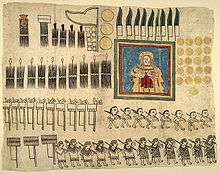
a codex page written on amate
Etymology 1
From Spanish papel amate (“amate paper”), from Classical Nahuatl āmatl (“paper”).
Pronunciation
- (UK) IPA(key): /əˈmɑːteɪ/
Noun
amate (plural amates)
- Paper produced from the bark of adult Ficus trees.
- An art form based on Mexican bark painting from the Otomi culture.
Translations
paper produced from Ficus bark
|
Etymology 2
From Old French amater, amatir.
Pronunciation
- (UK) IPA(key): /əˈmeɪt/
Verb
amate (third-person singular simple present amates, present participle amating, simple past and past participle amated)
- (obsolete) To dishearten, dismay.
- John Milton (1608-1674)
- The Silures, to amate the new general, rumoured the overthrow greater than was true.
- 1590, Edmund Spenser, The Faerie Qveene. […], London: […] William Ponsonbie, OCLC 960102938, book I, canto I:
- Shall I accuse the hidden cruell fate, / And mightie causes wrought in heauen aboue, / Or the blind God, that doth me thus amate, / For hoped loue to winne me certaine hate?
- 1600, Edward Fairfax, The Jerusalem Delivered of Tasso, XI, xii:
- Upon the walls the pagans old and young / Stood hush'd and still, amated and amazed.
- 1603, John Florio, transl.; Michel de Montaigne, The Essayes, […], printed at London: […] Edward Blount […], OCLC 946730821:, Folio Society, 2006, vol.1, p.230:
- For the last […], he will be much amazed, he will be much amated.
- c.1815, John Keats, "To Chatterton":
- Thou didst die / A half-blown flow'ret which cold blasts amate.
- John Milton (1608-1674)
Etymology 3
Verb
amate (third-person singular simple present amates, present participle amating, simple past and past participle amated)
Anagrams
Esperanto
Adverb
amate
- present adverbial passive participle of ami
Interlingua
Pronunciation
- IPA(key): /aˈma.te/
Participle
amate
- past participle of amar
Italian
Adjective
amate f pl
- feminine plural of amato
Noun
amate f
- plural of amata
Verb
amate
Anagrams
Latin
Verb
amāte
- second-person plural present active imperative of amō
Participle
amāte
- vocative masculine singular of amātus
Spanish
Etymology
From Classical Nahuatl āmatl (“paper”).
Pronunciation
- IPA(key): /aˈmate/, [aˈmat̪e]
Noun
amate m (plural amates)
Synonyms
- (amate paper): papel amate
Descendants
- English: amate
Further reading
- “amate” in Diccionario de la lengua española, Vigésima tercera edición, Real Academia Española, 2014.
This article is issued from
Wiktionary.
The text is licensed under Creative Commons - Attribution - Sharealike.
Additional terms may apply for the media files.