Luna
English
Etymology
From Latin lūna, by way of Middle English lune, luna (“the moon”).
Pronunciation
- IPA(key): /ˈlunə/
- Rhymes: -uːnə
Proper noun
Luna
- The name of Earth's moon.
- (Roman mythology) The sister of Aurora and Sol; the goddess of the moon; equivalent to the Greek Selene.
- A female given name..
- 1837 James Hogg, "The Mysterious Bride", Talks and Sketches: The Shepherd's Calendar (Blackie & Son), page 343:
- - - - and it so happened, that in one of old Bryan's daughters named Luna, or more familiarly Loony, he perceived, or thought he perceived, some imaginary similarity in form and air to the lovely apparition.
- 2003 J. K. Rowling, Harry Potter and the Order of the Phoenix (Bloomsbury, →ISBN, page 236:
- A few seconds later, Luna Lovegood emerged, trailing behind the rest of the class, a smudge of earth on her nose, and her hair tied in a knot on the top of her head.
- 1837 James Hogg, "The Mysterious Bride", Talks and Sketches: The Shepherd's Calendar (Blackie & Son), page 343:
- A given name for a female pet.
- (alchemy) Silver.
Coordinate terms
Derived terms
Translations
Earth's moon — see Moon
See also
Anagrams
Catalan
Proper noun
Luna f
- The Moon
Danish
Proper noun
Luna
- (Roman mythology) Luna
- A female given name. of modern usage.
German
Proper noun
Luna
- (Roman mythology) Luna
- A female given name. of modern usage.
Latin
Etymology 1
Noun
Lūna f (genitive Lūnae); first declension
- Alternative form of lūna; the Moon
- AD 334–7, Julius Firmicus Maternus (author), Wilhelm Kroll and Franz Skutsch (editors), Matheseos libri VIII, Leipzig: In aedibus B. G. Teubneri, volume I: Libros IV priores et quinti prooemium continens (1897), book iv, chapter i, § 10 (page 199, lines 16–19):
- Est itaque Luna aut synodica aut plena aut dichotomos aut menoides aut amficyrtos et per has mutata formas cursum menstrui luminis complet.
- (please add an English translation of this quote)
- AD 334–7, Julius Firmicus Maternus (author), Wilhelm Kroll and Franz Skutsch (editors), Matheseos libri VIII, Leipzig: In aedibus B. G. Teubneri, volume I: Libros IV priores et quinti prooemium continens (1897), book iv, chapter i, § 10 (page 199, lines 16–19):
Etymology 2
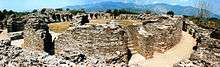
The city's amphitheatre
Pronunciation
- (Classical) IPA(key): /ˈluː.na/, [ˈɫuː.na]
Proper noun
Lūna f (genitive Lūnae); first declension
Declension
First declension.
| Case | Singular |
|---|---|
| nominative | Lūna |
| genitive | Lūnae |
| dative | Lūnae |
| accusative | Lūnam |
| ablative | Lūnā |
| vocative | Lūna |
Derived terms
- Lūnēnsis
References
- Luna in Gaffiot, Félix (1934) Dictionnaire Illustré Latin-Français, Hachette
- Luna in William Smith, editor (1854, 1857) A Dictionary of Greek and Roman Geography, volume 1 & 2, London: Walton and Maberly
Slovene
Etymology
See lúna.
Pronunciation
- IPA(key): /ˈlùːna/
- Tonal orthography: lúna
Proper noun
Lúna f (genitive Lúne)
- the Moon (of Earth)
Declension
Synonyms
See also
Spanish
Pronunciation
- IPA(key): /ˈluna/
Etymology 1
Proper noun
Luna f
Etymology 2
From dialectal Aragonese luna (“lights”), a habitational name for someone living by an open courtyard.
Proper noun
Luna f
- A surname.
This article is issued from
Wiktionary.
The text is licensed under Creative Commons - Attribution - Sharealike.
Additional terms may apply for the media files.