納豆
See also: 纳豆
Chinese
| to accept; to pay (tax etc.) | bean; sacrificial vessel | ||
|---|---|---|---|
| trad. (納豆) | 納 | 豆 | |
| simp. (纳豆) | 纳 | 豆 | |
Etymology
Pronunciation
Noun
納豆
Japanese
| Kanji in this term | |
|---|---|
| 納 | 豆 |
| なっ Grade: 6 |
とう Grade: 3 |
| on’yomi | |
Etymology
Possibly by extension from 納所 (nassho, “temple office for receiving donations”), and originally meaning beans (豆) from or in the 納所.[1][2]
Pronunciation
Noun
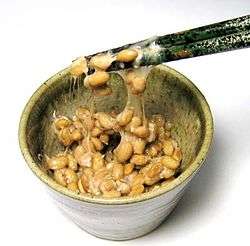
納豆 (hiragana なっとう, rōmaji nattō)
- natto (a traditional Japanese food product made from fermented soybeans)
Idioms
Idioms
- 納豆も豆なら豆腐も豆 (nattō mo mame nara tōfu mo mame): "if nattō is also beans, then tōfu is also beans" → a metaphor for how the same starting point can produce different results
Derived terms
Derived terms
- 納豆烏帽子 (nattō eboshi): common alternate word for 折烏帽子 (ori eboshi), a type of 烏帽子 (eboshi, “traditional Japanese formal black peaked hat”)
- 納豆菌 (nattō kin): Bacillus subtilis var. natto
- 納豆汁 (nattō jiru): a type of miso soup made with ground nattō, commonly served in winter
- 納豆売り (nattō uri): a nattō seller
- 納豆肥 (nattōgoe): a type of fertilizer made from fermented and composted soybeans, commonly used to fertilize tea bushes
See also
References
This article is issued from
Wiktionary.
The text is licensed under Creative Commons - Attribution - Sharealike.
Additional terms may apply for the media files.