檳榔
Chinese
| phonetic | |||
|---|---|---|---|
| trad. (檳榔) | 檳 | 榔 | |
| simp. (槟榔) | 槟 | 榔 | |
| alt. forms | 賓桹/宾桹 賓郎/宾郎 | ||
Etymology
Described in Qimin Yaoshu [544 CE] and Taiping Yulan [983 CE].
Borrowed from a Southern language, possibly a Mon-Khmer language. Compare Northern Khmer [script needed] (naːt-phlɤːŋ, “a kind of betel leaf bush”), Aheu phalʌ̰̂ː (“betel”), Malay pinang, as well as Proto-Mon-Khmer *ml[əw] (“betel”), whence Khmer ម្លូ (mluu), Vietnamese trầu (< Proto-Vietic *b-luː), Thai พลู (pluu) and perhaps Chinese 扶留 (OC *pa/ba m·ru/m·rus, “a leaf chewed together with betel nut”).
Pronunciation
Noun
檳榔
Synonyms
- (Min Nan) 菁仔
Derived terms
Descendants
References
- (Min Nan) “Entry #12549”, in 臺灣閩南語常用詞辭典 [Dictionary of Frequently-Used Taiwan Minnan] (in Chinese and Min Nan), Ministry of Education, R.O.C., 2011.
Japanese
Etymology 1
| Kanji in this term | |
|---|---|
| 檳 | 榔 |
| びん Hyōgaiji |
ろう Hyōgaiji |
| on’yomi | |
From Chinese 檳榔 (bīngláng), itself from Malay pinang.
Pronunciation
Noun
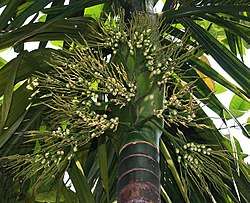
檳榔 (hiragana びんろう, katakana ビンロウ, rōmaji binrō, historical hiragana びんらう)
- Areca catechu, the areca or betel palm
Usage notes
As with many terms in biology, this term is often spelled in katakana.
Derived terms
Etymology 2
| Kanji in this term | |
|---|---|
| 檳 | 榔 |
| び Hyōgaiji |
ろう Hyōgaiji |
| Irregular | |
Unknown. From Chinese, but the use of this term as an alternative spelling is of uncertain derivation.
Pronunciation
Noun
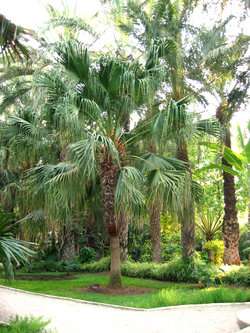
檳榔 (hiragana びろう, katakana ビロウ, rōmaji birō, historical hiragana びらう)
- alternative spelling of 蒲葵 (birō): Livistona chinensis, the Chinese fan palm
Usage notes
As with many terms in biology, this term is often spelled in katakana.