式神
Japanese
| Kanji in this term | |
|---|---|
| 式 | 神 |
| しき Grade: 3 |
じん Grade: 3 |
| on’yomi | |
| Kanji in this term | |
|---|---|
| 式 | 神 |
| しき Grade: 3 |
かみ > がみ Grade: 3 |
| jūbakoyomi | |
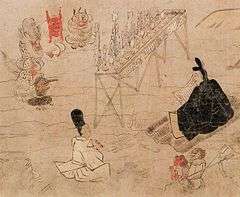
Abe no Seimei and his shikigami, (bottom right,) whom with which they all say grace before an assembly of God-like demon spirits
Alternative forms
Etymology
Compound of 式 (shiki, “ceremony”) + 神 (kami, “god, spirit”). The kami changes to gami due to rendaku (連濁).
Alternately, compound of 式 (shiki, “ceremony”) + 神 (jin, “god, spirit”).
Pronunciation
Noun
式神 (hiragana しきがみ, rōmaji shikigami, alternative reading しきじん, rōmaji shikijin)
- A kind of familiar spirit, summoned-up in service as a servant to the will of a practitioner of the onmyōdō (陰陽道) religion, very much like a western familiar.
See also

This article is issued from
Wiktionary.
The text is licensed under Creative Commons - Attribution - Sharealike.
Additional terms may apply for the media files.