八尺瓊勾玉
Japanese
| Kanji in this term | ||||
|---|---|---|---|---|
| 八 | 尺 | 瓊 | 勾 | 玉 |
| や Grade: 1 |
しゃく > さか Grade: 6 |
に Hyōgaiji |
まが Grade: S |
たま Grade: 1 |
| Irregular | ||||
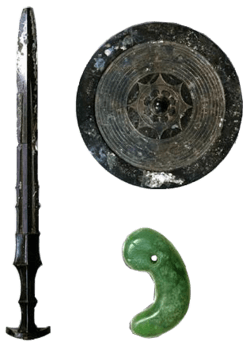
八尺瓊の勾玉: Artist's impressions of the (unseen) Imperial Regalia of Japan, with Yasakani no Magatama on the lower right
Alternative forms
Etymology
Phrase consisting of 八 (ya, “eight”) + 尺 (saka, alternate reading for shaku, an ancient unit of length similar to the English foot) + 瓊 (ni, “jade”, generally regarded as emphasizing the meaning of bead) + の (no, possessive particle) + 勾玉 (magatama, “curved bead”, an ancient comma-shaped jewelry bead made of jade or other materials).[1]
A literal interpretation of the name would suggest a magatama of around eight feet in size. However, magatama were never that large. An alternate theory is that this magatama is, or was, part of an eight-foot necklace.[1]
Pronunciation
Proper noun
八尺瓊勾玉 (hiragana やさかにのまがたま, rōmaji Yasakani no Magatama)
- the "Eight-Foot Curved Jewel", one of the three sacred treasures comprising the Imperial Regalia of Japan
See also
References
- 1 2 1988, 国語大辞典(新装版) (Kokugo Dai Jiten, Revised Edition) (in Japanese), Tōkyō: Shogakukan
- ↑ 1997, 新明解国語辞典 (Shin Meikai Kokugo Jiten), Fifth Edition (in Japanese), Tōkyō: Sanseidō, →ISBN
This article is issued from
Wiktionary.
The text is licensed under Creative Commons - Attribution - Sharealike.
Additional terms may apply for the media files.