草薙剣
Japanese
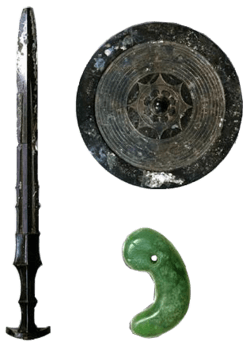
草薙の剣 (Kusanagi no Tsurugi): Artist's impressions of the (unseen) Imperial Regalia of Japan, with Kusanagi no Tsurugi on the left
| Kanji in this term | ||
|---|---|---|
| 草 | 薙 | 剣 |
| くさ Grade: 1 |
なぎ Jinmeiyō |
つるぎ Grade: S |
| kun’yomi | ||
Etymology
Phrase consisting of 草 (kusa, “grass”) + 薙 (nagi, “cutting; mowing”, the continuative or stem form of the verb 薙ぐ (nagu, “to cut; to mow”)) + の (no, possessive particle) + 剣 (tsurugi, “double-edged sword”).[1]
The name derives from a legend wherein the sword was used to cut grass, thereby saving the wielder from a deliberately-set fire. See the Wikipedia article for details.
Alternative forms
Pronunciation
Proper noun
草薙剣 (hiragana くさなぎのつるぎ, rōmaji Kusanagi no Tsurugi)
- the "Grasscutting Longsword", one of the three sacred treasures comprising the Imperial Regalia of Japan
Synonyms
See also
References
This article is issued from
Wiktionary.
The text is licensed under Creative Commons - Attribution - Sharealike.
Additional terms may apply for the media files.