walrus
English
WOTD – 25 August 2010
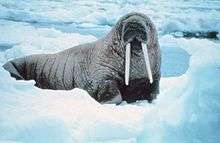
A walrus
Etymology
From Danish hvalros, an inversion of Old Norse hrosshvalr (“horse-whale”). The term may have entered English via Dutch walrus. Compare Icelandic hross (“a horse”) and hvalur (“a whale”), and German Walross.
Pronunciation
Noun
walrus (plural walruses or walrus or walrusses)
- A large Arctic marine mammal related to seals and having long tusks, tough, wrinkled skin, and four flippers, Odobenus rosmarus.
- 1887 — James W. Buel, Sea and Land, page 251.
- Of all the Phocine family none present so terrible and grotesque an appearance as the gigantic Walrus, also known as the morse and sea-horse.
- 1887 — James W. Buel, Sea and Land, page 251.
Quotations
- For more examples of usage of this term, see Citations:walrus.
Synonyms
Derived terms
Terms derived from walrus
Translations
large Arctic marine mammal
|
|
See also
Dutch
Etymology
The origin of this word is uncertain, with several theories proposed. The Old Norse hrossvalr (“horse-whale”) is thought to have been passed to Dutch in an inverted form as wal (“whale; large sea-animal”) + ros (“horse”). The inversion would likely have happened due to the influence of the already existing Dutch compound walvis (“whale, lit. whale-fish”). An alternate theory is that is comes from wal (“shore”) + reus (“giant”).
Pronunciation
- IPA(key): /ˈʋɑlrʏs/
-
audio (file)
Noun
walrus m (plural walrussen, diminutive walrusje n)
See also
This article is issued from
Wiktionary.
The text is licensed under Creative Commons - Attribution - Sharealike.
Additional terms may apply for the media files.