vaca
English
Alternative forms
Etymology
Pronunciation
- IPA(key): /ˌveɪ.keɪ/
Noun
vaca (plural vacas)
Anagrams
Asturian
Etymology
Noun
vaca f (plural vaques)
Catalan
Etymology
Pronunciation
Noun
vaca f (plural vaques)
Dalmatian
Alternative forms
Etymology
From Latin vacca (“cow”). Compare Italian vacca, Spanish vaca.
Noun
vaca f
Galician
Etymology
From Old Portuguese vaca, from Latin vacca.
Noun
vaca f (plural vacas)
See also
Italian
Verb
vaca
- inflection of vacare:
- third-person singular present indicative
- second-person singular imperative
Anagrams
Latgalian
Pronunciation
- IPA(key): /ˈvatsa/
Adjective
vaca f
Latin
Verb
vacā
- first-person singular present active imperative of vacō
Pali
Alternative forms
Alternative forms
- 𑀯𑀘 (Brahmi script)
- वच (Devanagari script)
- ৱচ (Bengali script)
- වච (Sinhalese script)
- ဝစ (Burmese script)
- วจ (Thai script)
- ᩅᨧ (Tai Tham script)
- វច (Khmer script)
Etymology
From Sanskrit वच (vaca).
Noun
vaca ?
Portuguese
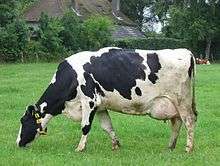
vaca
Pronunciation
Etymology 1
From Old Portuguese vaca, from Latin vacca, from Proto-Indo-European *wokeh₂-.
Noun
vaca f (plural vacas)
- cow
- (pejorative, slang) A promiscuous woman; bitch
Descendants
- Kadiwéu: waaca
See also
Etymology 2
Verb
vaca
- third-person singular (ele and ela, also used with você and others) present indicative of vacar
- second-person singular (tu, sometimes used with você) affirmative imperative of vacar
Romanian
Noun
vaca f
- definite singular nominative and accusative form of vacă.
Spanish
Etymology
From Latin vacca, from Proto-Indo-European *wokeh₂-.
Pronunciation
- IPA(key): /ˈbaka/
Noun
vaca f (plural vacas)
Derived terms
See also
Venetian
Etymology
Noun
vaca f (plural vache)
This article is issued from
Wiktionary.
The text is licensed under Creative Commons - Attribution - Sharealike.
Additional terms may apply for the media files.