Cygnus
See also: cygnus
Translingual
.jpg)
Etymology
Latin cygnus (“swan”), from Ancient Greek κύκνος (kúknos, “swan”)
Proper noun
Cygnus m
Usage notes
- Some of the swans, notably the North American trumpeter swan and tundra swan were earlier classified to the genus Olor, but they are now regarded as belonging to Cygnus.
Hypernyms
- (genus): Eukaryota - superkingdom; Animalia - kingdom; Bilateria - subkingdom; Deuterostomia - infrakingdom; Chordata - phylum; Vertebrata - subphylum; Gnathostomata - infraphylum; Reptilia - class; Aves - subclass; Ornithothoraces, Ornithurae - clades; Carinatae - subclass; Neornithes - infraclass; Neognathae - parvclass; Anseriformes - order; Anatidae - family; Anserinae - subfamily
Hyponyms
- (genus): Cygnus cygnus - type species; for other species see


References
-
-
-

English
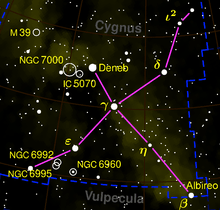
The constellation Cygnus
Etymology
Borrowed from Latin cygnus (“swan”), from Ancient Greek κύκνος (kúknos, “swan”)
Proper noun
Cygnus
- (astronomy) A summer constellation of the northern sky, said to resemble a swan. It includes the triple star system HD 188753 and the stars Deneb and Albireo.
- (Greek mythology) A king of the Ligurians and relative of Phaeton who was transformed into a swan and placed in the sky as a constellation.
Synonyms
- (constellation): Northern Cross
- (mythology): Cycnus
Derived terms
Related terms
Translations
constellation
Anagrams
Spanish
Proper noun
Cygnus ?
This article is issued from
Wiktionary.
The text is licensed under Creative Commons - Attribution - Sharealike.
Additional terms may apply for the media files.