seine
English
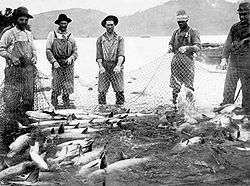
seining for salmon
Etymology
Old English seġne, from West Proto-Germanic *sagīna, from Latin sagēna, from Ancient Greek σαγήνη (sagḗnē, “dragnet”), of unknown origin.
Pronunciation
Noun
seine (plural seines)
- A long net having floats attached at the top and sinkers (weights) at the bottom, used in shallow water for catching fish.
- 1982, TC Boyle, Water Music, Penguin 2006, p. 169:
- They were too busy hauling at ropes, collectively drawing a large seine across the bay before them – and singing their hearts out.
- 1982, TC Boyle, Water Music, Penguin 2006, p. 169:
Translations
Verb
seine (third-person singular simple present seines, present participle seining, simple past and past participle seined)
- (transitive, intransitive) To use a seine, to fish with a seine.
Derived terms
Translations
Anagrams
Dutch
Pronunciation
-
Audio (file)
Verb
seine
- (archaic) singular present subjunctive of seinen
French
Etymology
Latin sagēna, from Ancient Greek σαγήνη (sagḗnē).
Pronunciation
- IPA(key): /sɛn/
Noun
seine f (plural seines)
- seine (for fishing)
Verb
seine
Further reading
- “seine” in le Trésor de la langue française informatisé (The Digitized Treasury of the French Language).
Anagrams
German
Pronunciation
- IPA(key): /ˈzaɪ̯nə/
-
Audio (file)
Pronoun
seine
Anagrams
Middle English
Verb
seine
- Alternative form of seien
Norman
Etymology
From Latin sagēna, from Ancient Greek σαγήνη (sagḗnē, “dragnet”).
Noun
seine f (plural seines)
Synonyms
Norwegian Bokmål
Adjective
seine
Norwegian Nynorsk
Adjective
seine
West Frisian
Etymology 1
Noun
seine c (plural seinen)
Etymology 2
Noun
seine c (plural seinen)
This article is issued from
Wiktionary.
The text is licensed under Creative Commons - Attribution - Sharealike.
Additional terms may apply for the media files.