raven
English
Etymology 1
From Middle English raven, reven, from Old English hræfn, from Proto-Germanic *hrabnaz (compare Icelandic hrafn, Dutch raaf, German Rabe, Danish and Norwegian Bokmål ravn, Norwegian Nynorsk ramn), from Proto-Indo-European *ḱorh₂- (compare Middle Irish crú, Latin corvus, Lithuanian šárka (“magpie”), Serbo-Croatian svrȁka ‘id.’, Ancient Greek κόραξ (kórax)), from *ḱer-, *ḱor- (compare Latin crepō (“I creak, crack”), Sanskrit कृपते (kṛpate, “he laments, he implores”)).
Pronunciation
- enPR: rāʹvən, IPA(key): /ˈɹeɪvən/
Audio (US) (file) - Rhymes: -eɪvən
Noun
raven (plural ravens)
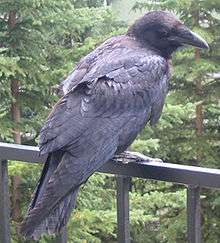
- A common name for several, generally large and lustrous black species of birds in the genus Corvus, especially the common raven, Corvus corax.
- c. 1588–1593, [William Shakespeare], The Most Lamentable Romaine Tragedie of Titus Andronicus: As It was Plaide by the Right Honourable the Earle of Darbie, Earle of Pembrooke, and Earle of Sussex Their Seruants (the First Quarto), London: Printed by Iohn Danter, and are to be sold by Edward White & Thomas Millington, at the little North doore of Paules at the signe of the Gunne, published 1594, OCLC 222241046, [Act II, scene iii]:
- Some ſay that Rauens foſter forlorne children, / The whilſt their owne birds famiſh in their neſts: / Oh be to me though thy hard hart ſay no, / Nothing ſo kinde but ſomething pittiful.
-
Derived terms
- Australian raven (Corvus coronoides)
- brown-necked raven (Corvus ruficollis)
- Chatham raven (Corvus moriorum)
- Chihuahuan raven (Corvus cryptoleucus)
- common raven (Corvus corax)
- dwarf raven (Corvus edithae)
- fan-tailed raven (Corvus rhipidurus)
- forest raven (Corvus tasmanicus)
- little raven (Corvus mellori)
- New Zealand raven (Corvus antipodum)
- northern raven (Corvus corax)
- pied raven
- raven-messenger
- relict raven (Corvus tasmanicus boreus)
- Somali raven (Corvus edithae)
- Tasmanian raven (Corvus tasmanicus)
- thick-billed raven (Corvus crassirostris)
- western raven (Corvus corax sinuatus)
- white-necked raven (Corvus albicollis)
Translations
|
|
Adjective
raven (not comparable)
- Of the color of the raven; jet-black
- raven curls
- raven darkness
- She was a tall, sophisticated, raven-haired beauty.
Derived terms
- nonraven
- raven-black
- raven-haired
- ravenhood
- raven standard
Translations
Etymology 2
From Old French raviner (“rush, seize by force”), itself from ravine (“rapine”), from Latin rapina (“plundering, loot”), itself from rapere (“seize, plunder, abduct”).
Alternative forms
Pronunciation
- enPR: răvʹən, IPA(key): /ˈɹævən/
- Rhymes: -ævən
Noun
raven (plural ravens)
Translations
Verb
raven (third-person singular simple present ravens, present participle ravening, simple past and past participle ravened)
- (transitive, archaic) To obtain or seize by violence.
- (transitive) To devour with great eagerness.
- 1938, P.G. Woodhouse, The Code of the Woosters,
- I refer to the danger of keeping a dog of this nature and disposition in a bedroom, where it can spring out ravening on anyone who enters.
- 1938, P.G. Woodhouse, The Code of the Woosters,
- (transitive) To prey on with rapacity.
- The raven is both a scavenger, who ravens a dead animal almost like a vulture, and a bird of prey, who commonly ravens to catch a rodent.
- (intransitive) To show rapacity; to be greedy (for something).
- 1587, Leonard Mascall, The First Booke of Cattell, London, “The nature and qualities of hogges, and also the gouernement thereof,”
- […] because hogs are commonly rauening for their meat, more then other cattel, it is meet therefore to haue them ringed, or else they wil doe much hurt in digging and turning vp corne fieldes […]
- 1852, Elizabeth Gaskell, “The Old Nurse’s Story” in The Old Nurse’s Story and Other Tales,
- They passed along towards the great hall-door, where the winds howled and ravened for their prey […]
- 1865, Sabine Baring-Gould, The Book of Were-Wolves, London: Smith, Elder & Co., Chapter 8, p. 114,
- The Greek were-wolf is closely related to the vampire. The lycanthropist falls into a cataleptic trance, during which his soul leaves his body, enters that of a wolf and ravens for blood.
- 1931, James B. Fagan, The Improper Duchess, London: Victor Gollancz, 1932, Act 3, p. 237,
- On one side the great temple where you can gather the good harvest—on the other a dirty little scandal that you’ve nosed out to fling to paper scavengers who feed it to their readin’ millions ravening for pornographic dirt.
- 1587, Leonard Mascall, The First Booke of Cattell, London, “The nature and qualities of hogges, and also the gouernement thereof,”
Related terms
Further reading


References
- Webster's Seventh New Collegiate Dictionary, Springfield, Massachusetts, G.&C. Merriam Co., 1967
- “raven” in Douglas Harper, Online Etymology Dictionary, 2001–2018.
Anagrams
Dutch
Etymology 1
Pronunciation
- IPA(key): /ˈreːvə(n)/
Verb
raven
Inflection
| Inflection of raven (weak) | ||||
|---|---|---|---|---|
| infinitive | raven | |||
| past singular | ravede | |||
| past participle | geraved | |||
| infinitive | raven | |||
| gerund | raven n | |||
| verbal noun | — | |||
| present tense | past tense | |||
| 1st person singular | rave | ravede | ||
| 2nd person sing. (jij) | ravet | ravede | ||
| 2nd person sing. (u) | ravet | ravede | ||
| 2nd person sing. (gij) | ravet | ravede | ||
| 3rd person singular | ravet | ravede | ||
| plural | raven | raveden | ||
| subjunctive sing.1 | rave | ravede | ||
| subjunctive plur.1 | raven | raveden | ||
| imperative sing. | rave | |||
| imperative plur.1 | ravet | |||
| participles | ravend | geraved | ||
| 1) Archaic. | ||||
Etymology 2
See etymology on the main entry.
Pronunciation
- IPA(key): /ˈraːvə(n)/
Audio (file) - Rhymes: -aːvən
Noun
raven
- Plural form of raaf
Anagrams
Middle Dutch
Alternative forms
- rāvene, rāve
Etymology
From Old Dutch *ravan, from Proto-Germanic *hrabnaz.
Noun
rāven m
Inflection
This noun needs an inflection-table template.
Alternative forms
Descendants
Further reading
- “raven”, in Vroegmiddelnederlands Woordenboek, 2000
- “raven”, in Middelnederlandsch Woordenboek, 1929
Slovene
Alternative forms
- raván (archaic)
Etymology
See Serbo-Croatian ravan
Pronunciation
- IPA(key): /ˈràːʋən/
- Tonal orthography: rávən
Adjective
ráven (comparative rávnejši, superlative nàjrávnejši)
Declension
| singular | |||
|---|---|---|---|
| masculine | feminine | neuter | |
| nominative | ráven ind rávni def |
rávna | rávno |
| accusative | nominativeinan or genitiveanim | rávno | rávno |
| genitive | rávnega | rávne | rávnega |
| dative | rávnemu | rávni | rávnemu |
| locative | rávnem | rávni | rávnem |
| instrumental | rávnim | rávno | rávnim |
| dual | |||
| masculine | feminine | neuter | |
| nominative | rávna | rávni | rávni |
| accusative | rávna | rávni | rávni |
| genitive | rávnih | rávnih | rávnih |
| dative | rávnima | rávnima | rávnima |
| locative | rávnih | rávnih | rávnih |
| instrumental | rávnima | rávnima | rávnima |
| plural | |||
| masculine | feminine | neuter | |
| nominative | rávni | rávne | rávna |
| accusative | rávne | rávne | rávna |
| genitive | rávnih | rávnih | rávnih |
| dative | rávnim | rávnim | rávnim |
| locative | rávnih | rávnih | rávnih |
| instrumental | rávnimi | rávnimi | rávnimi |