pour
English
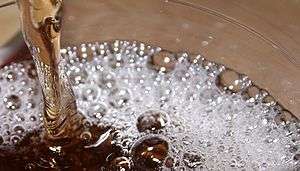
Pronunciation
- (Received Pronunciation) enPR: pô, IPA(key): /pɔː/
- (General American) enPR: pôr, IPA(key): /pɔɹ/
- (rhotic, without the horse–hoarse merger) enPR: pōr, IPA(key): /po(ː)ɹ/
- (non-rhotic, without the horse–hoarse merger) IPA(key): /poə/
Audio (US) (file) - Rhymes: -ɔː(ɹ)
- Homophone: pore; poor (in accents with the pour–poor merger); paw (non-rhotic accents with the horse–hoarse merger)
Etymology 1
From Middle English pouren (“to pour”). Origin uncertain. Likely of Celtic origin, from Celtic base *purr- (“to jerk, throw (water)”). Akin to Welsh bwrw (“to cast; to strike; to rain”), Scottish Gaelic purr (“to push, thrust, urge, drive”), Irish purraim (“I push, I jerk”). Compare Flemish pouren (“to pour”) (rare).
Displaced native Middle English schenchen, schenken (“to pour”) (from Old English scencan (“to pour out”)), ȝeoten, yetten (“to pour”) (from Old English ġēotan (“to pour”)), temen (“to pour out, empty”) (from Old Norse tœma (“to pour out, empty”)), birlen (“to pour, serve drink to”) (from Old English byrelian (“to pour, serve drink to”)), hellen (“to pour, pour out”) (from Old Norse hella (“to pour out, incline”)).
Verb
pour (third-person singular simple present pours, present participle pouring, simple past and past participle poured)
- (transitive) To cause to flow in a stream, as a liquid or anything flowing like a liquid, either out of a vessel or into it.
- to pour water from a pail
- to pour wine into a decanter
- to pour oil upon the waters
- to pour out sand or dust.
- (transitive) To send forth as in a stream or a flood; to emit; to let escape freely or wholly.
- 1599, William Shakespeare, “The Life of Henry the Fift”, in Mr. William Shakespeares Comedies, Histories, & Tragedies: Published According to the True Originall Copies (First Folio), London: Printed by Isaac Iaggard, and Ed[ward] Blount, published 1623, OCLC 606515358, [Act 5, prologue]:
- How London doth pour out her citizens.
- 1611, Bible (King James Version), 1 Samuel 1:15:
- […] I haue drunke neither wine nor strong drinke, but haue powred out my soule before the Lord.
- 1611, Bible (King James Version), Ezekiel 7:8:
- Now will I shortly powre out my furie vpon thee, and accomplish mine anger vpon thee […]
- 1637, John Milton, A Mask presented at Ludlow Castle, 1634, lines 710-711:
- Wherefore did Nature pour her bounties forth / With such a full and unwithdrawing hand?
- 2013 August 10, “Can China clean up fast enough?”, in The Economist, volume 408, number 8848:
- At the same time, it is pouring money into cleaning up the country.
-
- (transitive) To send forth from, as in a stream; to discharge uninterruptedly.
- A. Pope
- Is it for thee the linnet pours his throat?
- A. Pope
- (intransitive) To flow, pass or issue in a stream; to fall continuously and abundantly
- the rain poured down.
- (intransitive) to move in a throng, as a crowd
- Gay
- In the rude throng pour on with furious pace.
- 2011 January 8, Chris Bevan, “Arsenal 1-1 Leeds”, in BBC:
- In a breathless finish Arsenal poured forward looking for a winner but Leeds held out for a deserved replay after Bendtner wastefully fired wide and Schmeichel acrobatically kept out Denilson's rasping effort
- The people poured out of the theater.
- Gay
Synonyms
Derived terms
Translations
|
|
|
- The translations below need to be checked and inserted above into the appropriate translation tables, removing any numbers. Numbers do not necessarily match those in definitions. See instructions at Wiktionary:Entry layout#Translations.
Noun
pour (plural pours)
- The act of pouring.
- The bartender's inexpert pour left me with a pint of beer that was half foam.
- Something, or an amount, poured.
- 2003, John Brian Newman, B. S. Choo, Advanced concrete technology: Volume 2
- Over this time period, the first concrete pour has not only lost workability but has started to set so that it is no longer affected by the action of a vibrator.
- 2003, John Brian Newman, B. S. Choo, Advanced concrete technology: Volume 2
- (colloquial) A stream, or something like a stream; especially a flood of precipitation.
Translations
Etymology 2
Verb
pour
- Misspelling of pore.
Anagrams
Alemannic German
Noun
pour
References
- Umberto Patuzzi, ed., (2013) Ünsarne Börtar, Luserna: Comitato unitario delle linguistiche storiche germaniche in Italia / Einheitskomitee der historischen deutschen Sprachinseln in Italien.
French
Etymology
From Old French por, from Latin pro.
Pronunciation
- IPA(key): /puʁ/
audio (file)
Preposition
pour
- for (when followed by a noun or pronoun)
- J'ai un cadeau pour toi.
- I've got a gift for you.
- to (when followed by a verb at the infinitive)
- Je veux chanter pour te faire revenir.
- I want to sing to make you come back.
Derived terms
- pourboire m
- pour-cent m
- pour-compte m
Further reading
- “pour” in le Trésor de la langue française informatisé (The Digitized Treasury of the French Language).
Anagrams
Middle French
Etymology
Old French por, pur.
Preposition
pour
- for (indicates an intended aim or recipient)
- 1488, Jean Dupré, Lancelot du Lac, page 41:
- Dieu le scet que ie ne le faisoye se non pour bien & pour Dieu & pour franchise avoir
- God knows that I did for good, for God and to have freedom
- Dieu le scet que ie ne le faisoye se non pour bien & pour Dieu & pour franchise avoir
-
Descendants
- French: pour
Norman
Alternative forms
- pouor (Jersey)
Etymology
From Old French por, from Latin pro.
Preposition
pour
Romansch
Alternative forms
Etymology
Noun
pour m (plural pours)