pomander
English
WOTD – 1 November 2018
Etymology
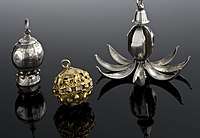

From Old French pome d'embre (literally “apple of ambergris”), from Medieval Latin pōmum dē ambra:[2] pōmum (“fruit”) (possibly from Old Latin *po-emo (“picked off”)); ambra (“amber; ambergris”) (probably from ambrosia (“food or unguent of the gods”), from ᾰ̓́μβροτος (“divine, immortal; belonging to the gods”), from Proto-Indo-European *n̥mr̥tós (“immortal”)).
Pronunciation
- (Received Pronunciation) IPA(key): /ˈpɒməndə/
- (General American) IPA(key): /ˈpɑməndɚ/
- Hyphenation: pom‧an‧der
Noun
pomander (countable and uncountable, plural pomanders)
- (countable, uncountable, historical) A mixture of aromatic substances, made into a ball and carried by a person to impart a sweet smell or as a protection against infection. [from late 15th c.]
- (countable, historical) A small case in which an aromatic ball was carried.
- (countable) A perforated container filled with pot-pourri for placing in a drawer, wardrobe, room, etc., to provide a sweet smell.
- (countable) An apple or orange studded with cloves used for the same purpose.
Translations
mixture of aromatic substances
small case in which an aromatic ball was carried
perforated container filled with pot-pourri
apple or orange studded with cloves
References
- ↑ From the collection of the Wellcome Library in London, England, UK.
- ↑ “pomander” (US) / “pomander” (UK) in Oxford Dictionaries, Oxford University Press.
Further reading

Anagrams
This article is issued from
Wiktionary.
The text is licensed under Creative Commons - Attribution - Sharealike.
Additional terms may apply for the media files.