pecan
English
Alternative forms
Etymology
Borrowed into English from the French word pacane and at first spelt paccan. The French word derives from an Algonquian word,[1] perhaps Miami (Illinois) pakani. Compare Cree pakan (“hard nut”), Ojibwe bagaan, Abenaki pagann, bagôn, pagôn (“nut; walnut, hazelnut”).
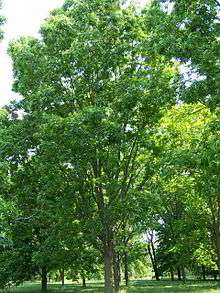
a 68-year-old pecan tree, Carya illinoinensis
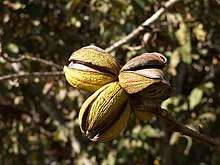
pecan nuts on a tree
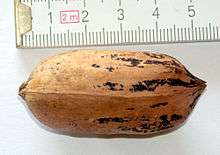
a pecan nut
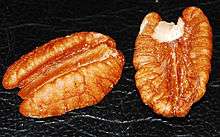
the edible portions of a pecan nut
Pronunciation
Pronunciation
- IPA(key): [ˌpi(ː)ˈkɑn] (pronunciation used by 32% of speakers in the US; common everywhere except New York, New England and the coastal Southeast)[2]
- Rhymes: -ɑːn
- IPA(key): [pɪˈkɑn] (used by 23% of speakers in the US, mostly in the southern Midwest; also used in the UK)[2][3][4]
- IPA(key): [ˈpiːˌkæn] (used by 14% of speakers in the US; common in New York, New England and the coastal Southeast; also used in the UK)[2][5][6]
- Rhymes: -æn
- IPA(key): [ˈpiːˌkɑn] (used by 13% of speakers in the US, mostly in the Upper Midwest)[2]
- IPA(key): [pi(ː)ˈkæn] (used by 7% of speakers in the US, not common in any region)[2]
- IPA(key): [ˈpɪk.æn] (used almost exclusively in coastal New England, and not the most common pronunciation even there)[2]
- IPA(key): [pəˈkɔːn], [pɪˈkɔːn] (used in Louisiana)[7]
- IPA(key): [pəˈkɑn] (sometimes used in the US when the word is unstressed)[5]
- IPA(key): [pɪˈkæn] (used in the UK; also used by some US speakers)[8][5]
- IPA(key): [ˈpiːkən] (used in the UK[4])
Noun
pecan (plural pecans)
- A deciduous tree, Carya illinoinensis, of the central and southern United States, having deeply furrowed bark, pinnately compound leaves, and edible nuts.
- 1885, Howard Seely, A Ranchman's stories, page 154:
- And away on the farther bank, a motte of huge pecans, standing like giant sentinels over the dwarfed landscape, filled the eye with remote vistas in their shady, twilight aisles. It was very still.
- 1978 April, in the Texas Monthly, page 51:
- Within its ornamental fence, the 8/10-acre property includes several of the largest live oaks in the area — plus huge pecans and stately magnolias.
- 1885, Howard Seely, A Ranchman's stories, page 154:
- A smooth, thin-shelled, edible oval nut of this tree.
- 1982, Beth Henley, Crimes of the heart, page 17:
- MEG. […] (Meg takes out two pecans and tries to open them by cracking them together.) Come on ... Crack, you demons! Crack!
- LENNY. We have a nutcracker!
- MEG. (Trying with her teeth.) Ah, where's the sport in a nutcracker? Where's the challenge?
- 1982, Beth Henley, Crimes of the heart, page 17:
- A half of the edible portion of the inside of this nut.
- 2005, in The Condensed Encyclopedia of Healing Foods (Joseph Pizzorno, Lara Pizzorno; Atria Books, →ISBN:
- Each shell contains two pecans, usually plump and oblong in shape, although some varieties are round or pointed.
- 2005, in The Condensed Encyclopedia of Healing Foods (Joseph Pizzorno, Lara Pizzorno; Atria Books, →ISBN:
Translations
tree
nut
|
See also
References
- ↑ 2005, Webster's New College Dictionary II →ISBN, page 829: [Algonquian paccan]
- 1 2 3 4 5 6 The Dialect Survey, and Joshua Katz' maps of it
- ↑ “pecan” in Dictionary.com Unabridged, Dictionary.com, LLC, 1995–present.
- 1 2 "pecan" in the Concise Oxford English Dictionary, 2008, WordReference.com
- 1 2 3 “pecan” in Merriam-Webster Online Dictionary
- ↑ Christopher Davies, Divided by a Common Language: A Guide to British and American English (2005-7)
- ↑ Claude E. Kantner, Variant Louisiana pronunciations of the word "pecan" (1944)
- ↑ Burkhard Dretzke, Modern British and American English pronunciation (2008)
Anagrams
Spanish
Pronunciation
- IPA(key): /ˈpekan/, [ˈpekãn]
Verb
pecan
This article is issued from
Wiktionary.
The text is licensed under Creative Commons - Attribution - Sharealike.
Additional terms may apply for the media files.