ostrich
English
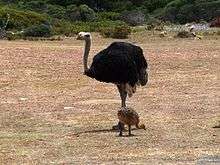
An ostrich and chick
Etymology
From Middle English ostrich, ostriche, ostryche, ostrige, from Anglo-Norman ostrige and Old French ostruce, from Latin avis (“bird”) + strūthiō (“ostrich”).
Pronunciation
- (Received Pronunciation) IPA(key): /ˈɒs.tɹɪt͡ʃ/, /ˈɒs.tɹɪd͡ʒ/; enPR: ŏs'trĭch, ŏs'trĭj
- (General American) IPA(key): /ˈɔs.tɹɪt͡ʃ/, /ˈɑs.tɹɪt͡ʃ/, /ˈɔs.tɹɪd͡ʒ/, /ˈɑs.tɹɪd͡ʒ/; enPR: ôs'trĭch, ŏs'trĭch, ôs'trĭj, ŏs'trĭj
Audio (US) (file) Audio (US) (2) (file)
Noun
ostrich (plural ostriches)
- A large flightless bird (Struthio camelus) native to Africa.
- 2013 July 26, Nick Miroff, “Mexico gets a taste for eating insects [… ]”, in The Guardian Weekly, volume 189, number 7, page 32:
- The San Juan market is Mexico City's most famous deli of exotic meats, where an adventurous shopper can hunt down hard-to-find critters such as ostrich, wild boar and crocodile.
-
Derived terms
Translations
large flightless bird
|
|
- The translations below need to be checked and inserted above into the appropriate translation tables, removing any numbers. Numbers do not necessarily match those in definitions. See instructions at Wiktionary:Entry layout#Translations.
Translations to be checked
|
See also
Further reading

Anagrams
Middle English
Alternative forms
Etymology
Borrowed from Anglo-Norman ostrige and Old French ostruce, from Vulgar Latin *austrūthiō.
Pronunciation
- IPA(key): /ˈɔstritʃ/, /ˈɔstridʒ/
Noun
ostrich (plural ostriches)
- ostrich (Struthio camelus)
- (rare) A goblet made of an ostrich egg.
- (rare, heraldry) A heraldic image of a ostrich.
Descendants
References
- “ostrich(e (n.(1))” in MED Online, Ann Arbor, Mich.: University of Michigan, 2007, retrieved 2018-06-4.
This article is issued from
Wiktionary.
The text is licensed under Creative Commons - Attribution - Sharealike.
Additional terms may apply for the media files.