struthio
See also: Struthio
Latin
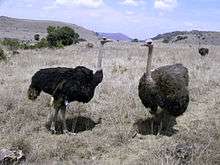
strūthiōnēs (ostriches)
Etymology
From Ancient Greek στρουθίων (strouthíōn); or shortened from strūthiocamēlus, from Ancient Greek στρουθιοκάμηλος (strouthiokámēlos), from στρουθόs (strouthós, “sparrow”) + κάμηλος (kámēlos, “camel”). The first element of both Greek words is likely related to Latin turdus (“thrush”).
Pronunciation
- (Classical) IPA(key): /ˈstruː.tʰi.oː/
Noun
strūthiō m (genitive strūthiōnis); third declension
Inflection
Third declension.
| Case | Singular | Plural |
|---|---|---|
| nominative | strūthiō | strūthiōnēs |
| genitive | strūthiōnis | strūthiōnum |
| dative | strūthiōnī | strūthiōnibus |
| accusative | strūthiōnem | strūthiōnēs |
| ablative | strūthiōne | strūthiōnibus |
| vocative | strūthiō | strūthiōnēs |
Synonyms
- (ostrich): strūthiocamēlus
Related terms
Descendants
References
- struthio in Charlton T. Lewis and Charles Short (1879) A Latin Dictionary, Oxford: Clarendon Press
- struthio in Charles du Fresne du Cange’s Glossarium Mediæ et Infimæ Latinitatis (augmented edition, 1883–1887)
- struthio in Gaffiot, Félix (1934) Dictionnaire Illustré Latin-Français, Hachette
This article is issued from
Wiktionary.
The text is licensed under Creative Commons - Attribution - Sharealike.
Additional terms may apply for the media files.