ledo
Esperanto
Etymology
Noun
ledo (accusative singular ledon, plural ledoj, accusative plural ledojn)
Galician
Etymology
From Old Portuguese ledo (“happy”), from Latin laetus (“happy”). Cognate with Portuguese ledo, Spanish ledo and Italian lieto.
Pronunciation
- IPA(key): /ˈleðo̝/, /ˈlɛðo̝/
Adjective
ledo m (feminine singular leda, masculine plural ledos, feminine plural ledas)
- happy, joyful
- c1350, Kelvin M. Parker (ed.), Historia Troyana. Santiago: Instituto "Padre Sarmiento", page 120:
- Agora vaamos ala et façamos o que podermos fazer et nõ aja y outro cõsello mays toda via fazede en guisa que bem çedo de [manãa] seja a villa çercada [per] força ou [per] al ca se nos tomamos Troya, ledos et cõ plazer tornaremos ha nossas terras
- Now, let's we go there and do what we can; we won't have another meeting; do anything to have the town sieged early in the morning, forcibly or in any way; because if we take Troy, we'll return happy and pleased to our lands
- Agora vaamos ala et façamos o que podermos fazer et nõ aja y outro cõsello mays toda via fazede en guisa que bem çedo de [manãa] seja a villa çercada [per] força ou [per] al ca se nos tomamos Troya, ledos et cõ plazer tornaremos ha nossas terras
- Synonym: alegre
- c1350, Kelvin M. Parker (ed.), Historia Troyana. Santiago: Instituto "Padre Sarmiento", page 120:
Related terms
- ledicia
- Ledo
References
- “ledo” in Dicionario de Dicionarios do galego medieval, SLI - ILGA 2006-2012.
- “ledo” in Xavier Varela Barreiro & Xavier Gómez Guinovart: Corpus Xelmírez - Corpus lingüístico da Galicia medieval. SLI / Grupo TALG / ILG, 2006-2016.
- “ledo” in Dicionario de Dicionarios da lingua galega, SLI - ILGA 2006-2013.
- “ledo” in Santamarina, Antón (coord.): Tesouro informatizado da lingua galega. Santiago de Compostela: Instituto da Lingua Galega.
- “ledo” in Álvarez, Rosario (coord.): Tesouro do léxico patrimonial galego e portugués, Santiago de Compostela: Instituto da Lingua Galega.
Italian
Verb
ledo
- first-person singular present indicative of ledere
Anagrams
Latin
Alternative forms
- lidūna
Etymology
Pronunciation
- (Classical) IPA(key): /ˈle.doː/, [ˈɫɛ.doː]
Noun
ledō m (genitive ledōnis); third declension
Inflection
Third declension.
| Case | Singular | Plural |
|---|---|---|
| nominative | ledō | ledōnēs |
| genitive | ledōnis | ledōnum |
| dative | ledōnī | ledōnibus |
| accusative | ledōnem | ledōnēs |
| ablative | ledōne | ledōnibus |
| vocative | ledō | ledōnēs |
See also
References
- ledo in Charles du Fresne du Cange’s Glossarium Mediæ et Infimæ Latinitatis (augmented edition, 1883–1887)
- ↑ Walde, Alois; Hofmann, Johann Baptist (1938), “ledo”, in Lateinisches etymologisches Wörterbuch (in German), volume 1, 3rd edition, Heidelberg: Carl Winter, page 779
Old Portuguese
Etymology
Pronunciation
- IPA(key): /ˈlɛ.do/
Adjective
ledo m (plural ledos, feminine leda, feminine plural ledas)
- happy
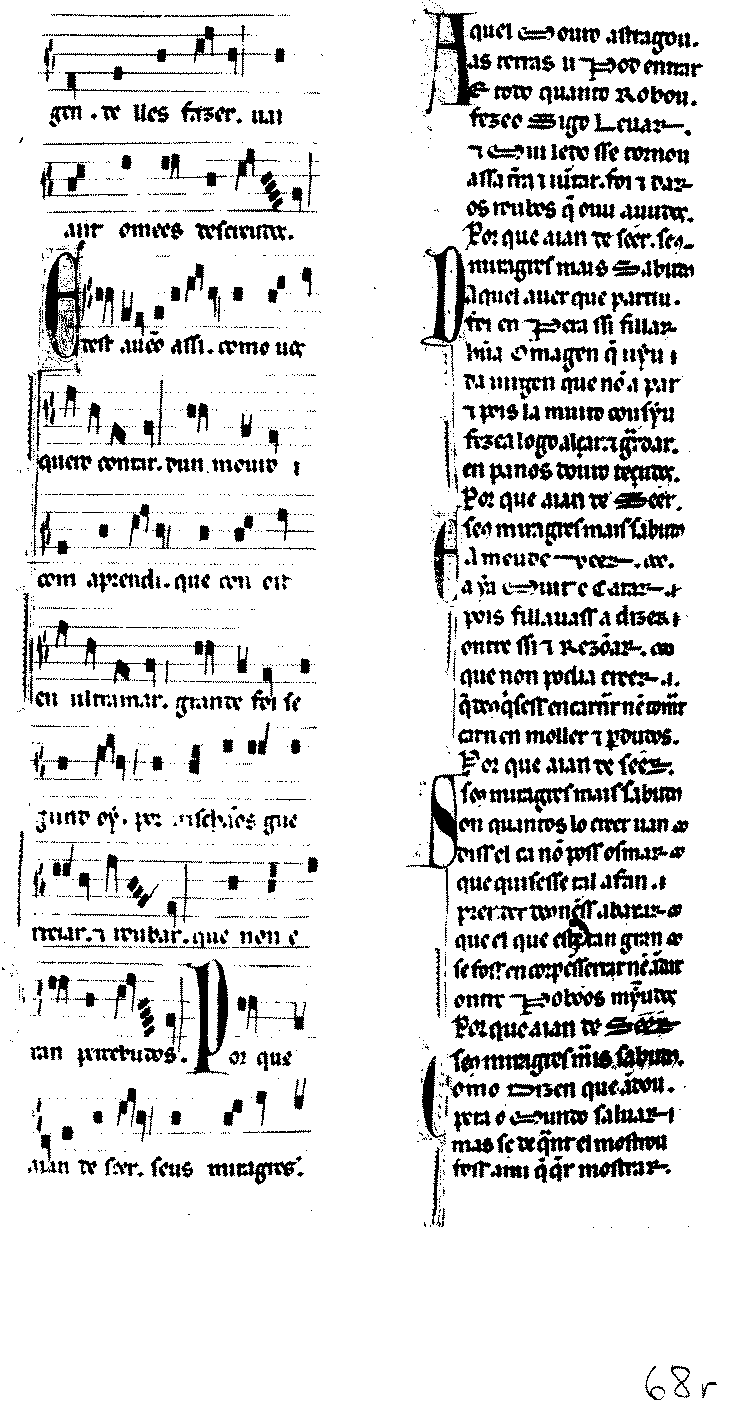
- 13th century, attributed to Alfonso X of Castile, Cantigas de Santa Maria, E codex, cantiga 46 (facsimile):
- […] Mui ledo ſſe tornou / aſſa t[er]ra […]
- […] he returned happy to his homeland […]
- […] Mui ledo ſſe tornou / aſſa t[er]ra […]
- 13th century, attributed to Alfonso X of Castile, Cantigas de Santa Maria, E codex, cantiga 46 (facsimile):
Descendants
Portuguese
Alternative forms
- lédo (obsolete)
Etymology
From Old Portuguese ledo (“happy”), from Latin laetus (“happy”). Cognate with Galician ledo, Spanish ledo and Italian lieto.
Pronunciation
Adjective
ledo m (feminine singular leda, masculine plural ledos, feminine plural ledas, comparable)
- happy, joyful
- 1572, Luís Vaz de Camões, Os Lusíadas, 3rd canto:
- Naquelle engano da alma, ledo & cego, / Que a fortuna não deixa durar muito,
- In that happy and blind illusion of the soul, / Which fortune does not allow to endure for long,
- 1572, Luís Vaz de Camões, Os Lusíadas, 3rd canto:
Derived terms
- ledamente
Related terms
Swedish
Verb
ledo
This article is issued from
Wiktionary.
The text is licensed under Creative Commons - Attribution - Sharealike.
Additional terms may apply for the media files.