gé
See also: Appendix:Variations of "ge"
Czech
Pronunciation
- IPA(key): [ˈɡɛː]
Noun
gé n
Further reading
- gé in Příruční slovník jazyka českého, 1935–1957
- gé in Slovník spisovného jazyka českého, 1960–1971, 1989
French
Pronunciation
- IPA(key): /ʒe/
Noun
gé m (plural gés)
Hungarian
Pronunciation
- IPA(key): [ˈɡeː]
Audio (file)
Noun
gé
Declension
This noun needs an inflection-table template.
Icelandic
Pronunciation
- IPA(key): /cɛː/
- Rhymes: -ɛː
Noun
gé n (genitive singular gés, nominative plural gé)
Declension
declension of gé
Irish
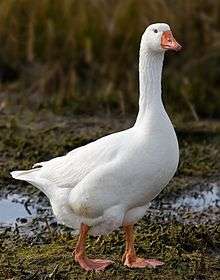
gé
Alternative forms
- géadh (archaic)
Etymology
From Middle Irish géd m (“goose”), from Proto-Celtic *gezdā. Cognate with Welsh gŵydd, Cornish goth and Breton gwaz.
Pronunciation
- IPA(key): /ɟeː/
Noun
gé f, m (genitive singular gé or géidh, nominative plural géanna or géidhe or géacha)
- goose (grazing waterfowl of the family Anatidae)
Declension
As feminine noun:
Declension of gé
Alternative nominative plural, feminine and masculine: géacha
As masculine noun (now archaic):
Hyponyms
- gandal m (“gander”)
Derived terms
- gé Cheanadach f (“Canada goose”)
- gé ghiúrainn f (“barnacle goose”)
- gé ghlas f (“greylag goose”)
Mutation
| Irish mutation | ||
|---|---|---|
| Radical | Lenition | Eclipsis |
| gé | ghé | ngé |
| Note: Some of these forms may be hypothetical. Not every possible mutated form of every word actually occurs. | ||
Further reading
- "gé" in Foclóir Gaeilge-Béarla, An Gúm, 1977, by Niall Ó Dónaill.
- “géd” in Dictionary of the Irish Language, Royal Irish Academy, 1913–76.
- “gé” in Foclóir Gaeḋilge agus Béarla, Irish Texts Society, 2nd ed., 1927, by Patrick S. Dinneen.
- Entries containing “gé” in English-Irish Dictionary, An Gúm, 1959, by Tomás de Bhaldraithe.
- Entries containing “gé” in New English-Irish Dictionary by Foras na Gaeilge.
Mandarin
Romanization
gé (Zhuyin ㄍㄜˊ)
- Pinyin transcription of 佮
- Pinyin transcription of 匌
- Pinyin transcription of 呄
- Pinyin transcription of 嗝
- Pinyin transcription of 噶
- Pinyin transcription of 塥
- Pinyin transcription of 嶮
- Pinyin transcription of 愅
- Pinyin transcription of 挌
- Pinyin transcription of 揶
- Pinyin transcription of 搿
- Pinyin transcription of 擱
- Pinyin transcription of 敋
- Pinyin transcription of 格
- Pinyin transcription of 槅
- Pinyin transcription of 浦
- Pinyin transcription of 滄
- Pinyin transcription of 烖
- Pinyin transcription of 獦
- Pinyin transcription of 砗
- Pinyin transcription of 胳
- Pinyin transcription of 膈
- Pinyin transcription of 臵
- Pinyin transcription of 茖
- Pinyin transcription of 葛
- Pinyin transcription of 蛒
- Pinyin transcription of 蛤
- Pinyin transcription of 裓
- Pinyin transcription of 觡
- Pinyin transcription of 諽
- Pinyin transcription of 輵, 轕
- Pinyin transcription of 郃
- Pinyin transcription of 鉀
- Pinyin transcription of 鉻
- Pinyin transcription of 鎘
- Pinyin transcription of 铬
- Pinyin transcription of 镉
- Pinyin transcription of 閗
- Pinyin transcription of 閣
- Pinyin transcription of 閤
- Pinyin transcription of 闔
- Pinyin transcription of 阁
- Pinyin transcription of 阖
- Pinyin transcription of 隔
- Pinyin transcription of 革
- Pinyin transcription of 鞇
- Pinyin transcription of 鞷
- Pinyin transcription of 韐
- Pinyin transcription of 韚
- Pinyin transcription of 領
- Pinyin transcription of 颌
- Pinyin transcription of 骼
- Pinyin transcription of 髂
- Pinyin transcription of 鬬
- Pinyin transcription of 鬲
- Pinyin transcription of 鮯
- Pinyin transcription of 鰪
- Pinyin transcription of 齃
Old Irish
Pronunciation
- IPA(key): /ɡʲeː/
Verb
·gé
- third-person singular present subjunctive conjunct of guidid
Mutation
| Old Irish mutation | ||
|---|---|---|
| Radical | Lenition | Nasalization |
| ·gé | ·gé pronounced with /-ɣ(ʲ)-/ |
·ngé |
| Note: Some of these forms may be hypothetical. Not every possible mutated form of every word actually occurs. | ||
This article is issued from
Wiktionary.
The text is licensed under Creative Commons - Attribution - Sharealike.
Additional terms may apply for the media files.