flail
English

Etymology
From Middle English flaile, flayle, from earlier fleil, fleyl, fleȝȝl, flegl, from Old English fligel, *flegel (“flail”), from Proto-Germanic *flagilaz (“flail, whip”), of uncertain origin. Perhaps related to Old French fil and Latin fīlum ("a fine thread or wire, a filament", i.e. a defiling instrument for the thrashing of a wire). Cognate with Scots flail (“a thresher's flail”), West Frisian fleil, flaaiel (“flail”), Dutch vlegel (“flail”), Low German vlegel (“flail”), German Flegel (“flail”). Possibly a native Germanic word from Proto-Germanic *flag-, *flah- (“to whip, beat”), from Proto-Indo-European *plak-, *plāk- (“to beat, hit, strike; weep”); compare Lithuanian plàkti (“to whip, lash, flog”), Ancient Greek πληγνύναι (plēgnúnai, “strike, hit, encounter”), Latin plangō (“lament”, i.e. “beat one's breast”) + Proto-Germanic *-ilaz (instrumental suffix); or a borrowing of Latin flagellum, diminutive of flagrum (“scourge, whip”), from Proto-Indo-European *bʰlag-, *bʰlaǵ- (“to beat”); compare Old Norse blekkja (“to beat, mistreat”). Compare also Old French flael (“flail”), Walloon flayea (“flail”) (locally pronounced "flai"), Italian flagello (“scourge, whip, plague”).
Pronunciation
- IPA(key): /fleɪl/
Audio (US) (file) - Rhymes: -eɪl
Noun
flail (plural flails)
- A tool used for threshing, consisting of a long handle with a shorter stick attached with a short piece of chain, thong or similar material.
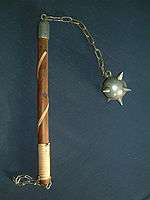
- A weapon which has the (usually spherical) striking part attached to the handle with a flexible joint such as a chain.
Quotations
- 1631 — John Milton, L'Allegro
- When in one night, ere glimpse of morn,
His shadowy flail hath threshed the corn
That ten day-labourers could not end;
- When in one night, ere glimpse of morn,
- 1816 — Samuel Taylor Coleridge, Kubla Khan
- Huge fragments vaulted like rebounding hail,
Or chaffy grain beneath the thresher's flail
- Huge fragments vaulted like rebounding hail,
- 1842 — Henry Wadsworth Longfellow, The Slave in the Dismal Swamp
- On him alone the curse of Cain
Fell, like a flail on the garnered grain,
And struck him to the earth!
- On him alone the curse of Cain
- 1879 — Henry George, Progress and Poverty, ch V
- If the farmer must use the spade because he has not capital enough for a plough, the sickle instead of the reaping machine, the flail instead of the thresher...
Translations
|
|
|
- The translations below need to be checked and inserted above into the appropriate translation tables, removing any numbers. Numbers do not necessarily match those in definitions. See instructions at Wiktionary:Entry layout#Translations.
|
|
Coordinate terms
- (weapon): nunchaku
Verb
flail (third-person singular simple present flails, present participle flailing, simple past and past participle flailed)
- (transitive) To beat using a flail or similar implement.
- (transitive) To wave or swing vigorously
- Synonym: thrash
- 1937, H. P. Lovecraft, The Evil Clergyman
- He stopped in his tracks – then, flailing his arms wildly in the air, began to stagger backwards.
- (transitive) To thresh.
- (intransitive) To move like a flail.
- He was flailing wildly, but didn't land a blow.
Translations
|
See also