dusk
English
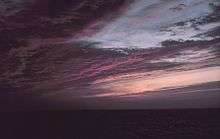
Dusk
Etymology
From Middle English dosk, duske (“dusky”, adj.), from Old English dox (“dark, swarthy”), from Proto-Germanic *duskaz (“dark, smoky”), from Proto-Indo-European *dʰūs- (compare Old Irish donn (“dark”), Latin fuscus (“dark, dusky”), Sanskrit धूसर (dhūsara, “dust-colored”)), from Proto-Indo-European *dʰewh₂- (“smoke, mist, haze”). More at dye. Related to dust.
Pronunciation
- (UK) IPA(key): /dʌsk/
-
Audio (US) (file) - Rhymes: -ʌsk
Noun
dusk (plural dusks)
- A period of time at the end of day when the sun is below the horizon but before the full onset of night, especially the darker part of twilight.
- A darkish colour.
- Dryden
- Whose dusk set off the whiteness of the skin.
- Dryden
Synonyms
Antonyms
Hypernyms
Hyponyms
- astronomical dusk
- civil dusk
- nautical dusk
Translations
period of time at the end of day when sun is below the horizon but before full onset of night
|
|
See also
Verb
dusk (third-person singular simple present dusks, present participle dusking, simple past and past participle dusked)
- (intransitive) To begin to lose light or whiteness; to grow dusk.
- Alfred Edward Housman, More Poems, XXXIII, lines 25-27
- I see the air benighted
- And all the dusking dales,
- And lamps in England lighted,
- Alfred Edward Housman, More Poems, XXXIII, lines 25-27
- (transitive) To make dusk.
- Holland
- After the sun is up, that shadow which dusketh the light of the moon must needs be under the earth.
- Holland
Translations
Adjective
dusk (comparative dusker, superlative duskest)
- Tending to darkness or blackness; moderately dark or black; dusky.
- Milton
- A pathless desert, dusk with horrid shades.
- Milton
See also
- dusk at OneLook Dictionary Search
Anagrams
This article is issued from
Wiktionary.
The text is licensed under Creative Commons - Attribution - Sharealike.
Additional terms may apply for the media files.