convex
English
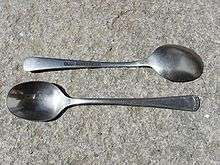
Top: a spoon with its convex side up.
Bottom: a spoon with its concave side up.
Bottom: a spoon with its concave side up.
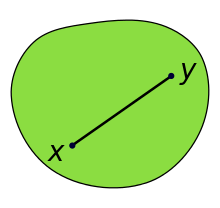
A convex set. For any points x and y within the set, the connecting line lies within the set.

A convex polygon.
Etymology
Borrowed from Middle French convexe, from Latin convexus (“arched”).
Pronunciation
- (Received Pronunciation) IPA(key): /ˈkɒnvɛks/
- (General American) IPA(key): /ˈkɑnvɛks/
- The noun was often stressed on the second syllable by early writers, such as Milton, and occasionally by later poets.
Adjective
convex (comparative more convex, superlative most convex)
- curved or bowed outward like the outside of a bowl or sphere or circle
- Whewell
- Drops of water naturally form themselves into figures with a convex surface.
- Whewell
- (mathematics, not comparable, of a set) arranged such that for any two points in the set, a straight line between the two points is contained within the set.
- (geometry, not comparable, of a polygon) having no internal angles greater than 180 degrees.
- (functional analysis, not comparable, of a real-valued function on the reals) having an epigraph which is a convex set.
Antonyms
Derived terms
Terms derived from convex
Translations
curved or bowed outward like the outside of a bowl or sphere or circle
|
|
Noun
convex (plural convexes)
References
- “convex” in John A. Simpson and Edward S. C. Weiner, editors, The Oxford English Dictionary, 2nd edition, Oxford: Clarendon Press, 1989, →ISBN.
Catalan
Etymology
Pronunciation
Adjective
convex (feminine convexa, masculine plural convexos, feminine plural convexes)
Antonyms
Related terms
Further reading
- “convex” in Diccionari de la llengua catalana, segona edició, Institut d’Estudis Catalans.
This article is issued from
Wiktionary.
The text is licensed under Creative Commons - Attribution - Sharealike.
Additional terms may apply for the media files.