chive
See also: chivé
English
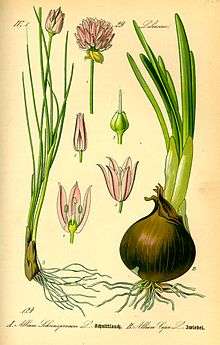
Chive (left) and onion (right)
Etymology 1
Middle English, from Old French cive, from Latin cepa (“onion”).
Pronunciation
- IPA(key): /tʃaɪv/
Audio (US) (file) - Rhymes: -aɪv
Noun
chive (plural chives)
- A perennial plant, Allium schoenoprasum, related to the onion.
- (in plural chives) The leaves of this plant used as a herb.
Translations
plant
|
|
chives: herb
|
|
See also
References
- “chive” in Webster’s New Collegiate Dictionary: Based on Webster’s Third New International Dictionary, 8th edition, Springfield, Mass.: G[eorge] & C[harles] Merriam, 1973 (1974 printing), OCLC 299192187.



- chive at USDA Plants database
Etymology 2
From Romani chive, chiv, chivvomengro (“knife, dagger, blade”).
Alternative forms
- chieve, chife, chiv
Noun
chive (plural chives)
- (thieves' cant) A knife.
- 1712, “A Budg and Snudg Song”, in Farmer, John Stephen, editor, Musa Pedestris, published 1896, page 32:
- For when that he hath nubbed as, / And our friends tip him no cole, / He takes his chive and cuts us down, / And tips us into a hole.
- 1841, Miles, Henry Downes, chapter XXXIX, in Dick Turpin, 4th edition, London: William Mark Clark, published 1845, page 267:
- None of us know'd then—though the grabbing at Nan Turner's came off that very night—as Polly was the cause o' that 'ere, till it vos blown here at the Gate by some of the coves. Vell, she nammused, as you may guess, but fust poor old Madge Rhodes got a chive in her breather from Black Gil.
- 1879 October 1, Horsley, Rev. John William, “Autobiography of a Thief”, in Macmillan's Magazine, volume 40, page 503:
- On the Boxing Day after I came out I got stabbed in the chest by a pal of mine who had done a schooling. We was out with one another all the day getting drunk, so he took a liberty with me, and I landed him one on the conk (nose), so we had a fight, and he put the chive (knife) into me.
- 1888 February 12, “A Plank-Bed Ballad”, in The Referee, reprinted in Farmer, John Stephen, edtor, Musa Pedestris, published 1896, page 185:
- I guyed, but the reeler he gave me hot beef, / And a scuff came about me and hollered; / I pulled out a chive but I soon same to grief, / And with screws and a james I was collared.
-
- (thieves' cant) A file.
- (thieves' cant) A saw.
Derived terms
- chive fencer (“street seller of cutlery”)
- shiv (“makeshift knife”)
Verb
chive (third-person singular simple present chives, present participle chiving, simple past and past participle chived)
- (thieves' cant) To stab.
- 1868 May 1, Cassell's Magazine, page 80:
- He was as good a man as Jacky at any weapon that could be named, and if Jacky were game for a chiving (stabbing) match, he (Kavanagh) was ready for him.
- (thieves' cant) To cut.
Derived terms
- chive the darbies (“to cut off fetters”)
- chiving lay (“theft by cutting coach components”)
- chiving the froe (“theft by cutting women's pockets”)
- shiv (“to stab”)
References
- Grose, Francis (1788) A Classical Dictionary of the Vulgar Tongue, 2nd edition, London: S. Hooper
- “chive” in Albert Barrère and Charles G[odfrey] Leland, compilers and editors, A Dictionary of Slang, Jargon & Cant, volume I (A–K), Edinburgh: The Ballantyne Press, 1889–1890, page 246.
- Farmer, John Stephen (1891) Slang and Its Analogues, volume 2, pages 97–98
- Eric Partridge, A Dictionary of the Underworld, London, Macmillan Co., 1949
Spanish
Verb
chive
This article is issued from
Wiktionary.
The text is licensed under Creative Commons - Attribution - Sharealike.
Additional terms may apply for the media files.