stab
English
Etymology
First attested in Scottish English (compare Scots stob, stobbe, stabb (“a pointed stick or stake; a thrust with a pointed weapon”)), from Middle English stabbe (“a stab”), probably a variant of Middle English stob, stub, stubbe (“pointed stick, stake, thorn, stub, stump”), from Old Norse stobbi, stubbi, cognate with Old English stybb. Cognate with Middle Dutch stobbe.
Supposed by some to derive from Scottish Gaelic stob (“to prick, to prod, to push, to thrust”); supposed by others to be from a Scots word.
Pronunciation
- enPR: stăb, IPA(key): /stæb/
Audio (US) (file) - Hyphenation: stab
- Rhymes: -æb
Noun
stab (plural stabs)
- An act of stabbing or thrusting with an object.
- A wound made by stabbing.
- Pain inflicted on a person's feelings.
- (informal) An attempt.
- I'll give this thankless task a stab.
- Criticism.
- (music) A single staccato chord that adds dramatic impact to a composition.
- a horn stab
- A bacterial culture made by inoculating a solid medium, such as gelatin, with the puncture of a needle or wire.
Derived terms
Derived terms
- have a stab at, take a stab at
- stab in the back
- stab in the dark
Translations
act of stabbing
|
wound made by stabbing
pain inflicted on a person's feelings
Verb
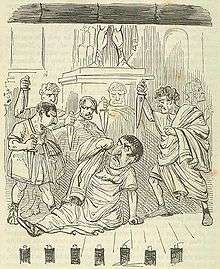
a man about to be stabbed
stab (third-person singular simple present stabs, present participle stabbing, simple past and past participle stabbed)
- (transitive) To pierce or to wound (somebody) with a pointed tool or weapon, especially a knife or dagger.
- 1905, Baroness Emmuska Orczy, chapter 1, in The Tremarn Case:
- “There the cause of death was soon ascertained ; the victim of this daring outrage had been stabbed to death from ear to ear with a long, sharp instrument, in shape like an antique stiletto, which […] was subsequently found under the cushions of the hansom. […]”
- If you stab him in the heart he won't live long enough to retaliate.
-
- (transitive) To thrust in a stabbing motion.
- to stab a dagger into a person
- (intransitive) To recklessly hit with the tip of a pointed object, such as a weapon or finger (often used with at).
- John Dryden
- None shall dare / With shortened sword to stab in closer war.
- He stabbed at my face with the twig but luckily kept missing my eyes.
- John Dryden
- (intransitive) To cause a sharp, painful sensation (often used with at).
- The snow from the blizzard was stabbing at my face as I skied down the mountain.
- (transitive, figuratively) To injure secretly or by malicious falsehood or slander.
- to stab a person's reputation
Derived terms
Translations
To pierce or wound with pointed object
|
|
To recklessly hit with the tip of a pointed object
Anagrams
Danish
Etymology
Noun
stab c (singular definite staben, plural indefinite stabe)
Inflection
Declension of stab
Swedish
Etymology
Pronunciation
audio (file)
Noun
stab c
- a staff
Declension
| Declension of stab | ||||
|---|---|---|---|---|
| Singular | Plural | |||
| Indefinite | Definite | Indefinite | Definite | |
| Nominative | stab | staben | staber | staberna |
| Genitive | stabs | stabens | stabers | stabernas |
References
This article is issued from
Wiktionary.
The text is licensed under Creative Commons - Attribution - Sharealike.
Additional terms may apply for the media files.